About Calystegia sepium (L.) R.Br.
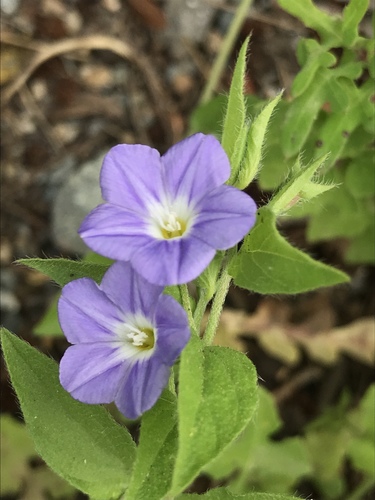
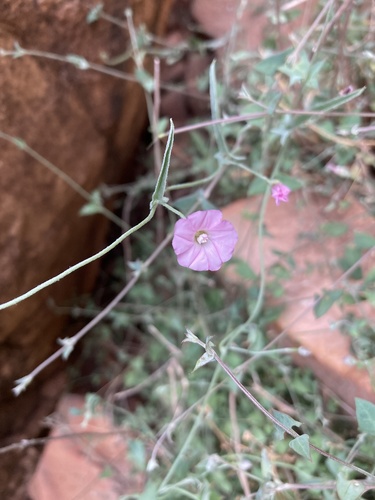
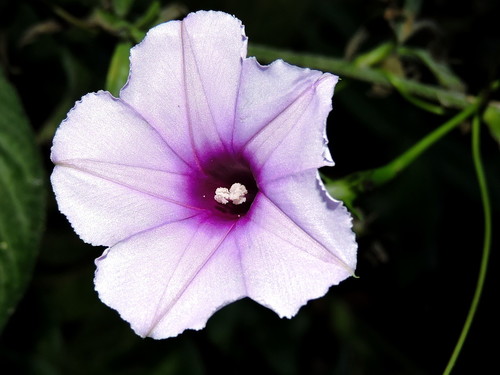
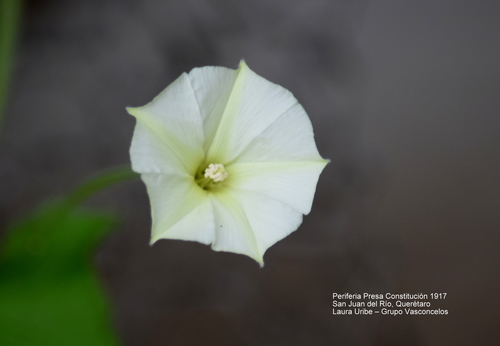
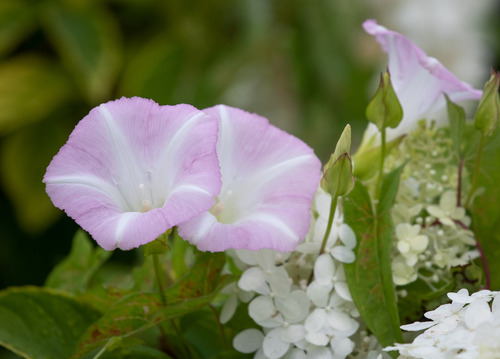
Calystegia sepium (L.) R.Br. is an herbaceous perennial that twines counter-clockwise, growing up to 3 meters (10 feet) in height. Its leaves are arranged alternately along the spiraling stem; they are dull green on the upper surface and paler below, simple and sagittate (arrowhead shaped), 5 to 10 centimeters (2 to 4 inches) long, and 3 to 7 centimeters (1+1⁄4 to 2+3⁄4 inches) broad. Flowers are white, sometimes with pink windows, and are produced from late spring to the end of summer (between July and September in northern Europe). Flower buds are enclosed by large, 2 centimeters (3⁄4 inch) long, ovate-lanceolate green bracteoles that have keels and burgundy margins; the bracteoles do not overlap, or only barely overlap, during anthesis. Open flowers are trumpet-shaped, with a diameter of 3 to 7 centimeters (1+1⁄4 to 2+3⁄4 inches). After flowering, the plant develops an almost spherical fruit capsule, 1 centimeter (1⁄2 inch) in diameter, that is hidden by the plant's bracts. This capsule holds two to four large, dark brown or black seeds shaped like quartered oranges. The plant grows well in hedges, fields, borders, roadsides and open woods. It is toxic, containing calystegine alkaloids. Multiple species of Calystegia grow in similar habitats and can be hard to tell apart, especially when not flowering. In Britain, it is common practice to treat C. sepium, C. silvatica and C. pulchra as an aggregate group, usually recorded as "C. sepium agg." when identification cannot be confirmed. Use of this aggregate term sometimes causes confusion over which specific taxon is being discussed. The most reliable feature to distinguish C. sepium from other related taxa is the form of the bracteoles that grow beneath the flower and wholly or partially enclose the sepals. C. sepium has two rather long, narrow bracteoles that do not touch each other, while both large bind and hairy bind have shorter, wider bracteoles that overlap where they meet.