About Calypte anna (R.Lesson, 1829)
Size Measurements
Anna's hummingbirds, scientifically named Calypte anna, measure 3.9 to 4.3 inches (9.9 to 10.9 cm) in length, have a 4.7-inch (12 cm) wingspan, and weigh between 0.1 and 0.2 ounces (2.8 to 5.7 grams).
General Plumage
They have an iridescent bronze-green back, pale grey chest and belly, green flanks, and long, straight, slender bills.
Adult Male Plumage
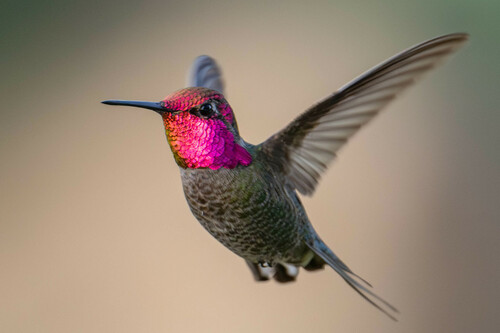
Adult males have an iridescent crown and gorget that ranges from crimson-red (derived from magenta) to reddish-pink; these features look dull brown or gray without direct sunlight, and males also have a dark, slightly forked tail. Males of this species are the only North American hummingbirds with a red crown.
Female Plumage
Females also have iridescent red gorgets, though these are usually smaller and less brilliant than males' gorgets. Females and juvenile males have a dull green crown, a grey throat that may or may not have some red iridescence, a grey chest and belly, and a dark, rounded tail with white tips on the outer feathers.
Iridescence Function
The male's striking reddish-pink crown and gorget are strongly iridescent, and their appearance changes based on the angle of illumination and observation by other birds, whether females or competing males.
Iridescence Biological Basis
This iridescence comes from large stacks of melanosomes arranged in layers separated by keratin within the feather barbules. The barbules reflect incoming light in the same way as partially opened Venetian blinds, creating the iridescence that changes the color of the head and gorget as the light angle shifts.
Iridescence Mating Benefit
This color change gives males an advantage for attracting mates and defending territories. Males with higher protein levels in their diet have more colorful crowns and stronger iridescence in their head feathers than males with low protein intake.
Male Vocalization
The male's call is scratchy and metallic, and it is typically given while the male perches in trees and shrubs.
Urban Habitat Adaptation
This species has adapted to urban environments, and is commonly seen in backyards, parks, at bird feeders, and around flowering plants.
Diet
Anna's hummingbirds eat flying insects.
Core Distribution Range
This species is found along the western coast of North America, from southern Canada to northern Baja California, and inland to southern and central Arizona, extreme southern Nevada, southeastern Utah, and western Texas.
Vagrancy Records
They are usually permanent residents across their range, but individual birds have been spotted far outside their native range in locations including southern Alaska, Idaho, Saskatchewan, New York, Florida, Louisiana, and Newfoundland.
Altitudinal Range Expansion
In response to rising low-elevation temperatures caused by 21st century climate change, Anna's hummingbirds have expanded their range into cooler summer habitats at higher altitudes, reaching up to 2,825 metres (9,268 ft) in the mountainous terrain of California, such as the Sierra Nevada.
Range Uniqueness
Anna's hummingbirds have the northernmost year-round range of any hummingbird species.
Northern Population History
Individuals were first recorded in Alaska as early as 1971, and have been resident in the Pacific Northwest since the 1960s, with resident populations growing particularly quickly during the early 21st century. Scientists estimate that some birds overwinter and likely breed at northern latitudes when food and shelter are available through the winter, and they can tolerate moderately cold winter temperatures.
Cold Weather Adaptation
When temperatures are cold, Anna's hummingbirds gain weight gradually over the course of the day as they convert sugar to fat.
Historical Range
Originally, their range was limited only to the chaparral of California and Baja California, but it expanded north into Oregon, Washington, and British Columbia, and east into Arizona during the 1960s and 1970s.
Range Expansion Drivers
This rapid expansion is linked to the widespread planting of non-native species such as eucalyptus, human use of urban bird feeders, and the species' natural tendency to disperse widely after breeding. In the Pacific Northwest, the fastest growing populations occur in regions where breeding-season cold temperatures match those of the species' native range.
Ecological Release Context
The northward range expansion of Anna's hummingbird is an example of ecological release, driven by introduced plants, year-round nectar availability from human-supplied bird feeders, milder winter temperatures potentially linked to climate change, and the species' acclimation to winter climates cooler than its native region.
Partial Migration Hypothesis
As of 2017, no quantitative data is available, but it is likely that a sizable portion of Anna's hummingbirds in the Pacific Northwest still migrate south for the winter.
Pollination Role
While collecting nectar from flowers, Anna's hummingbirds help pollinate plants. Research shows that Anna's hummingbirds generate an electrostatic charge while in flight that makes pollen stick to their beaks and feathers, letting them transfer pollen grains to hundreds of flowers each day as they forage for nectar.
Body Shaking Behavior
Anna's hummingbirds can shake their bodies 55 times per second to shed rain while flying, or to remove pollen or dirt from their feathers in dry weather. Each full body twist lasts just four hundredths of a second, and applies 34 times the force of gravity to the bird's head.