About Calvia quatuordecimguttata (Linnaeus, 1758)
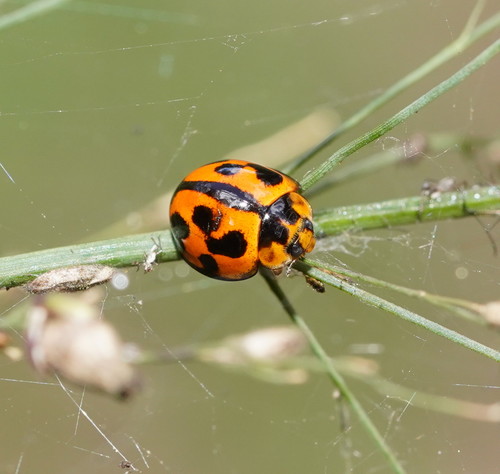
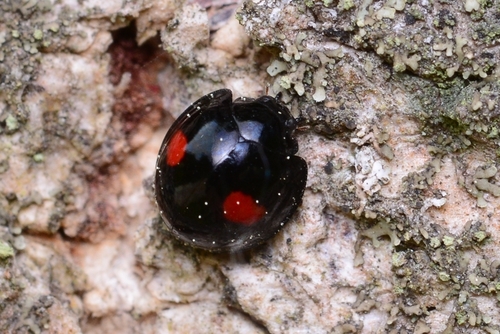
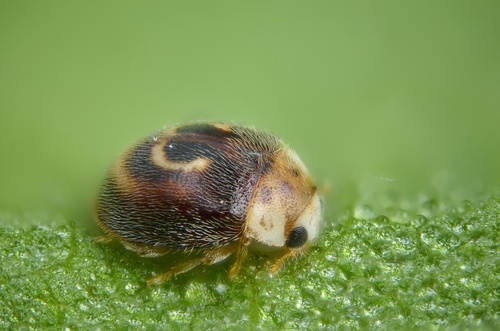
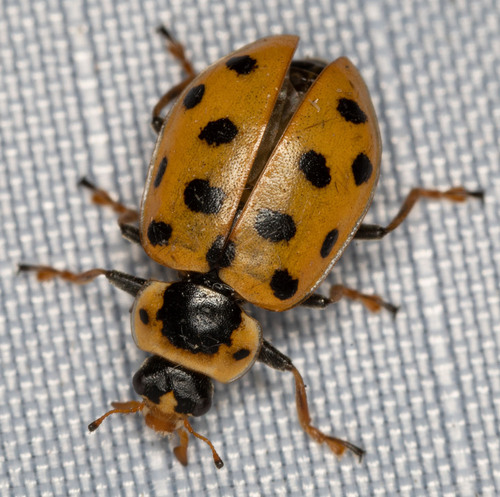
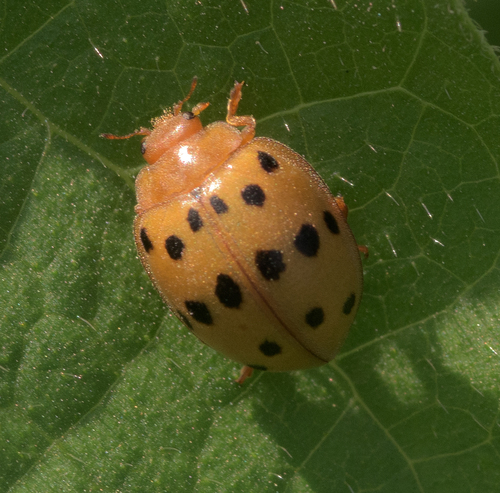
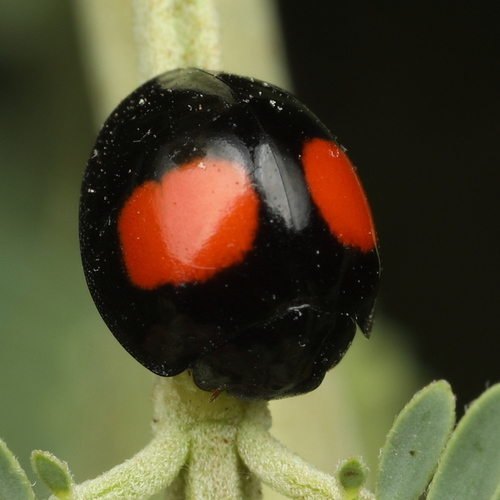
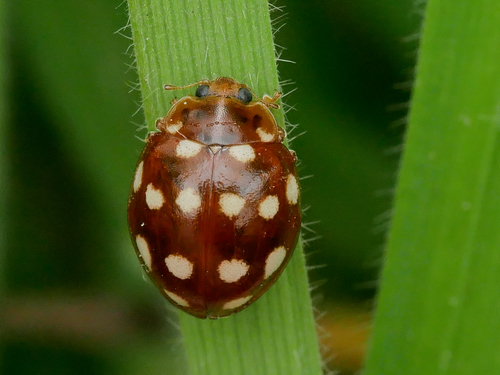
The cream-spot ladybird, Calvia quatuordecimguttata, measures 4 to 5.5 millimetres (0.16 to 0.22 in) long and 3.2 to 4.5 millimetres (0.13 to 0.18 in) broad. This species shows high colouration variation in North America and parts of eastern temperate Asia, while European populations have consistent colouring: maroon-brown with fourteen cream-coloured spots. In other parts of its range, it can appear as black with white spots (darker than the standard European form), anywhere from yellow to pink with 18 large blotches, or an all-black excessively melanistic form with a large red-orange patch on each elytron. It always has a glossy pronotum, and its black abdominal segments have a thin red rim on the underside. Larvae are black with white markings, have six legs, and bear several blunt conical spines on each abdominal segment. They are similar to Cycloneda larvae, but have shorter legs. The cream-spot ladybird has a Holarctic distribution. In North America, its range extends from Alaska and Labrador south to California and New Jersey, where it is an introduced species. Its Palearctic range covers Europe, North Africa, Cyprus, European Russia, the Caucasus, Siberia, the Russian Far East, Belarus, Ukraine, Moldova, Transcaucasia, Kazakhstan, western Asia, Pakistan, Mongolia, China, and Japan. It is found throughout Britain and Ireland, and is more common in England than in areas further west and north. This species lives in a wide variety of environments: deciduous and mixed forests including Western European broadleaf forests, as well as ruderal areas, parks, gardens, and meadows, found on grasses, bushes, and trees. It also occurs in forest litter, on brushwood, in moss, in coarse woody debris, and in compost. It is entomophagous, feeding on aphids, Aleyrodidae, coccids, Coccoidea, and the larvae and eggs of some beetles and butterflies. One study recorded its preferred aphid prey as the aspen leaf aphid Chaitophorus tremulae, the angelica aphid Cavariella konoi, the small willow aphid Aphis farinosa, the lime-tree aphid Eucallipterus tiliae, the birch aphid Euceraphis betulae, and the mugwort aphid Macrosiphoniella artemisiae. It overwinters in leaf litter, crevices in tree bark, and other similar protective locations.