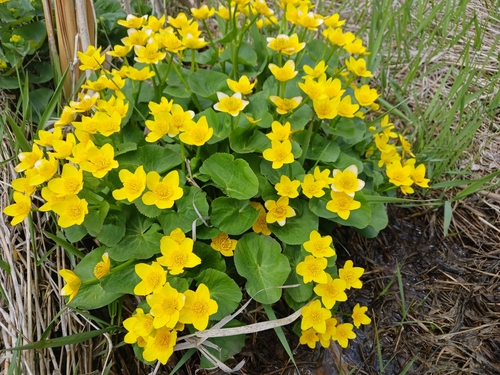
About Caltha palustris var. radicans (T.F.Forst.) Beck
Caltha palustris var. radicans is a variety of Caltha palustris, which is a hairless, fleshy perennial herbaceous plant. It grows between 10 and 80 centimetres (4 to 31+1⁄2 inches) tall. It dies back completely in autumn, and overwinters using buds located near the surface of marshy soil. Plants have many strongly branching roots that are 2 to 3 millimetres (3⁄32 to 1⁄8 inch) thick. Its flowering stems are hollow, and are either erect or more or less decumbent. Alternate true leaves grow in a rosette. Each leaf has a petiole that is roughly four times as long as its kidney-shaped leaf blade. Leaf blades measure between 3 and 25 cm (1+1⁄4 to 9+3⁄4 inches) long, and 3 to 20 cm (1+1⁄4 to 7+3⁄4 inches) wide. Each leaf has a heart-shaped base, a blunt tip, and a margin that ranges from scalloped to toothed, and is sometimes almost entire particularly near the tip. When leaves are young, they are protected by a membranous sheath that can reach up to 3 cm (1+1⁄4 inches) long in fully grown plants. This variety of Caltha palustris is native to temperate regions of the Northern Hemisphere, where it grows in marshes, fens, ditches, and wet woodland. It can also be found across much of the northeastern United States. Caltha palustris, also called marsh-marigold, grows in locations where oxygen-rich water is present near the soil surface. It prefers nutrient-rich soils, but dislikes fertilizer application and avoids habitats with high concentrations of phosphate and ammonium, and does not grow in brackish water. It is often found growing with iron-rich seepage; iron ions react with phosphate to make phosphate unavailable to plants, and the resulting insoluble mineral forms rust-colored flocs on the water, soil, and stem surfaces of marsh plants. Marsh-marigold grows alongside reeds around the edges of lakes and rivers, and can be found in black alder coppices and other regularly flooded, permanently moist forests. When it blooms, it often visually dominates the area where it grows. It was once common in wet meadows, but agricultural rationalization has now restricted it to ditches. It is a component of purple moor grass and rush pastures, a Biodiversity Action Plan habitat type in the UK, and occurs on poorly drained neutral and acidic soils in lowlands and upland fringe. In western Europe, the marsh-marigold moth Micropterix calthella bites open the anthers of marsh-marigold and other plants to feed on pollen. The moth's caterpillars, active in summer and autumn, also feed on marsh-marigold, though they are sometimes found feeding on mosses instead. Another insect visitor to Caltha palustris in western Europe is the leaf beetle Prasocuris phellandrii, which is black with four orange stripes, measures around ½ cm long, and feeds on the plant's sepals. The larvae of this beetle live inside hollow stems of plants in the parsley family. In Illinois, USA, two leaf beetle species, Plateumaris nitida and Hydrothassa vittata, can be found living on Caltha. Maggots from some Phytomyza species in the family Agromyzidae are leaf miners that develop inside Caltha leaves. The flowers of Caltha palustris produce both nectar and large amounts of pollen that attract many insect visitors. Hoverflies (family Syrphidae) are the most common pollinators. In Canada, a wide range of insect taxa have been observed visiting the leaves or flowers of Caltha palustris, including beetles from the families Cantharidae, Nitidulidae, Coccinellidae, Chrysomelidae, Cerambycidae; thrips from Thripidae; bugs from Miridae; butterflies from Pieridae; sawflies from Tenthredinidae; bees from Apidae, Halictidae, Andrenidae; ants from Formicidae; and flies from Sepsidae, Sciomyzidae, Ephydridae, Syrphidae, Anthomyiidae, Tachinidae, and Muscidae. Many of these insects were found carrying Caltha pollen. In addition to pollination by insects, this plant is adapted to rain-pollination. Caltha palustris does not produce fertile seed when self-pollinated. Relatively high fertility in crosses between sibling plants indicates this sterility trait is genetically regulated by multiple genes. This regulatory mechanism is also found in the genus Ranunculus, and is known to occur only in these two genera. All Caltha plants, including Caltha palustris, contain multiple active substances, and protoanemonin is the most important from a toxicological perspective. Eating large quantities of the plant can cause convulsions, throat burning, vomiting, bloody diarrhea, dizziness, and fainting. Contact of skin or mucous membranes with the plant's juice can cause blistering or inflammation, and ingestion causes gastric illness. Younger plant parts tend to contain lower amounts of toxic compounds, and heating breaks these toxic substances down. Small amounts of Caltha in hay do not cause health problems for livestock, but larger quantities lead to gastric illness. Additionally, plants growing in raw water may carry toxic organisms, which can be neutralized by cooking. Early spring greens and flower buds of Caltha palustris are edible after cooking, but are poisonous when raw. To prepare, young leaves or buds should be submerged multiple times in fresh boiling water until barely tender, cut into bite-sized pieces, lightly salted, and served with melted butter and vinegar. Very young flower buds can be prepared similarly to capers and used as a spice. Common marsh marigold is grown as an ornamental plant across temperate regions worldwide, and is sometimes recommended for low-maintenance wildlife gardens. The double-flowered cultivar 'Flore Pleno' has received the Royal Horticultural Society's Award of Garden Merit.