About Caltha obtusa Cheeseman
Taxonomic Identity and Growth Form
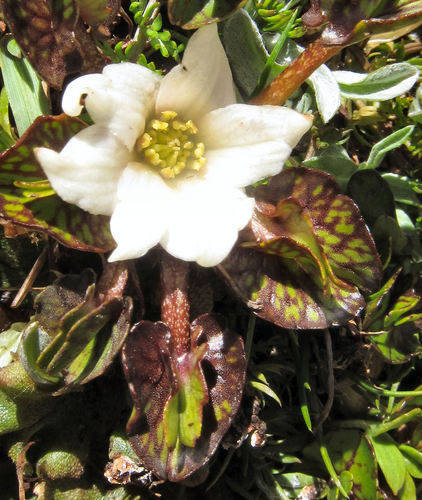
Caltha obtusa Cheeseman is a small, hairless, perennial herb that grows 2–6 cm high. This species forms mats of rosettes, and has stout, fleshy white rhizomes.
Leaf Petiole Characteristics
Its leaves are spade-shaped, growing on slender petioles 8–12 mm long that form a membranous sheathing base.
Leaf Blade Features
Leaf blades range from dark green to yellowish green, and sometimes have bronze blotches or streaks; they measure 8–12 mm long by 7.5–11 mm wide, have two lobes at the base, an indent at the tip, and deeply scalloped edges, especially near the leaf base. The basal lobes, or appendages, are mostly pressed against the upper surface of the leaf, are more than half the length of the leaf blade, and also have a deeply scalloped outer margin.
Sepal Characteristics
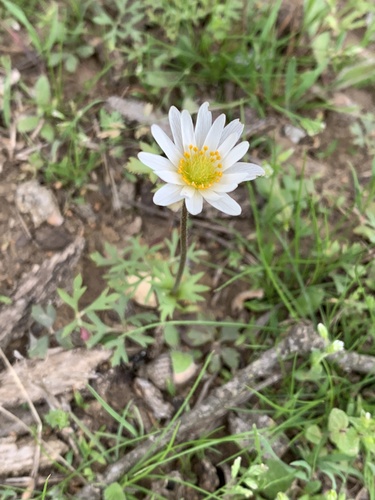
Each flower has five white obovate sepals, 8–18 mm long and 6–12 mm wide, that are widest between the tip and middle of the sepal, and have an obtuse to acute tip.
Reproductive Flower Parts
Between ten and fifteen stamens encircle free narrow-ovate carpels, each carpel around 4–5 mm long and topped with a rather long, slender style. Flowers of this species are reported to smell like lemon.
Fruit and Seed Traits
Fruiting heads are 12–18 mm across, and follicles reach 1.25–1.5 cm in length. Seeds rarely ripen in this species.
Flowering and Fruiting Period
Flowering occurs between December and February, and fruits can be found from February to April.
Chromosome Count
Caltha obtusa has a chromosome count of 2n = 48.
Species Distribution
In terms of distribution and ecology, Caltha obtusa, also called white caltha, occurs in the mountains of New Zealand's South Island, from Canterbury southwards.
Habitat Types
It grows along alpine streams and seepages, and around mountain lakes. It can also be found in moist open grasslands and wet areas among gravel and herbs.