About Caltha biflora DC.
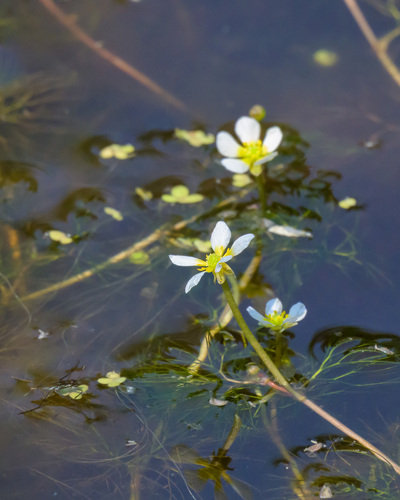
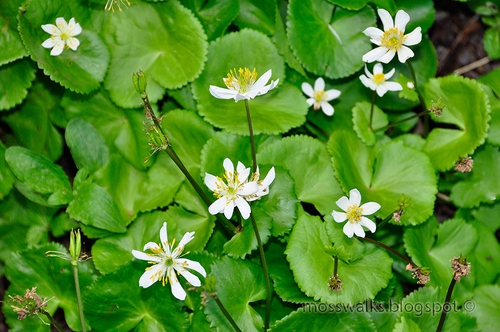
This description covers the morphological characteristics, distribution, ecology, and other traits of all species within the Caltha genus. All Caltha species are hairless perennial herbs, growing from 1 to 80 cm tall. They have alternate leaves and all bear stalked basal leaves; some species also have one or a few leaves growing on the flower stalk. Leaf structure differs between species groups. All Northern Hemisphere species have simple leaves. C. sagittata has one pair of lobes at the leaf base, which are mostly oriented at a right angle to the larger upper lobe, though they may lie in the same plane in some northern populations of this species. All other Southern Hemisphere Caltha species have basal lobes that merge with the upper lobe to form two (occasionally three) appendages attached adjacent to the midvein; the adaxial surfaces of the upper lobe and appendages face each other, a condition called diplophylly. Northern Hemisphere species have kidney to elongated heart-shaped leaves and stipules, with margins that are simple, toothed, or scalloped. Southern Hemisphere species have a wide range of leaf shapes: in C. appendiculata the upper lobe is usually somewhat trifid with an indent at the tip of each segment, but it is also often spoon-shaped with an entire margin and a somewhat retuse tip; in C. dionaeifolia the upper lobe splits into two ovate left and right halves that are distinctly folded toward each other (plicate), have a concave upper surface, an entire margin with regularly spaced tooth-like hairs, and similarly shaped appendages that are half to two-thirds the size of the upper lobe; C. sagittata has wide arrowhead-shaped leaves with an entire margin and triangular appendages about two-thirds the size of the upper lobe; C. intriloba has narrow arrowhead-shaped to elongated ovate leaves with slightly scalloped margins and lanceolate-triangular appendages two-thirds as long as the upper lobe; C. novae-zelandiae has spade-shaped leaves slightly longer than wide, with a rounded, slightly retuse tip, a slightly scalloped margin, and half-as-long triangular appendages with blunt tips; C. obtusa also has spade-shaped leaves with a rounded, slightly retuse tip, but these leaves are about as wide as long and distinctly scalloped, especially toward the base, and have three-quarter-as-long appendages with a matching scalloped outer margin and a straight, entire inner margin. Flowers are actinomorphic, and lack true petals and nectaries. They have four to thirteen colored sepals, most often five to nine. Sepal color ranges from yellow (rarely orange or red) to white, sometimes tinged pink or magenta, and sepal shape varies from broadly ovate and obtuse to oblong or lanceolate. Flower arrangement differs by hemisphere: Southern Hemisphere species produce solitary flowers on a short stalk in the center of the basal leaf rosette, while Northern Hemisphere species mostly form few-flowered corymbs with no, or one to a few mostly sessile leaf-like stipules. Stamen counts range from 6–9 in the smallest species C. dionaeifolia to 60–120 in the largest species C. palustris, and carpel counts similarly range between 2–5 and 5–25. Stamens encircle the carpels, and both grow from a flat floral base. Pollen is typically yellow and tricolpate, with exceptions: C. leptosepala ssp. howellii has pollen with rounded apertures across the entire surface (pantoporate) or an intermediate pantocolporate type, and C. palustris var. alba has both pollen types. Each carpel holds several ovules arranged along the ventral suture. Ovules mostly develop into sessile follicles, containing elliptic to globular, wingless light brown to black seeds that measure between 0.5 and 1.5 mm depending on the species. C. scaposa has stipitate follicles, while C. leptosepala has follicles that are shortly stipitate to sessile. C. natans grows floating in fresh water or on mud, while all other Caltha species are terrestrial plants that grow in moist soil. Caltha species are distributed across cold and temperate regions of the Northern Hemisphere, the Andes, Patagonia, and alpine areas of Australia and New Zealand. The genus is absent from lower elevations in the tropics and subtropics, Africa, Greenland and some other Arctic islands, Antarctica and subantarctic islands, and all oceanic islands. Individual species have specific ranges: C. natans occurs in Siberia and North America, but not Europe; C. palustris has the widest distribution, found across cold and temperate Northern Hemisphere, but is absent from the Western United States; C. scaposa is an alpine species with a limited range on the southeastern rim of the Tibetan Highlands; C. leptosepala occurs in western North America from Alaska to California and Colorado; C. sagittata grows in moist alpine meadows from Colombia to Tierra del Fuego, occurring at lower elevations farther from the equator; C. appendiculata grows in the moist mountains and hills of southern Patagonia; the four remaining species all have limited ranges: C. dionaeifolia is found on the southern tip of Patagonia, C. introloba in the Australian Alps and Tasmania, C. novae-zelandiae in the mountains of New Zealand's North and South Islands, and C. obtusa is restricted to New Zealand's South Island. C. palustris is cultivated as a garden ornamental in all temperate regions, and has sometimes escaped cultivation. Most ecological information about Caltha is limited to C. palustris. This species, like other ranunculids, contains harmful chemicals including anemonin, which is likely why vertebrate animals avoid all members of the family. Beetles and mining fly larvae cause little damage to C. palustris. C. palustris is pollinated by a wide variety of insects, most prominently flies, bees, and beetles. While it has been suggested that rain could assist pollination in this species, evidence also shows C. palustris is self-infertile. When ripe follicles open, they form a 'splash cup'; when a raindrop strikes at the correct angle, seeds are expelled out of the follicle. C. palustris seeds also contain spongy tissue that allows them to float on water until they wash up on a suitable site for growth. C. introloba has a life cycle adapted to long-lasting snow cover and a short growing season. Its flower buds are fully developed before the first seasonal snow falls, so flowers can open immediately after snow melts in spring. Its seeds germinate better and faster after exposure to a cold period.