About Calotropis gigantea (L.) W.T.Aiton
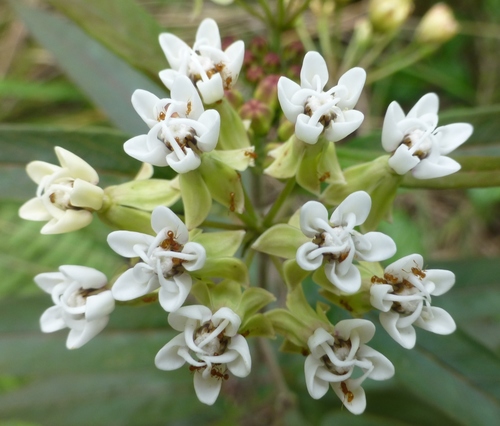
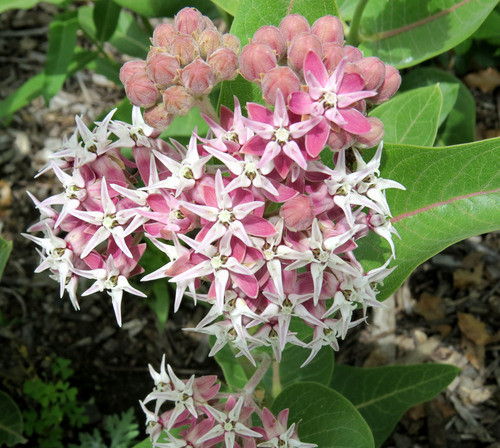
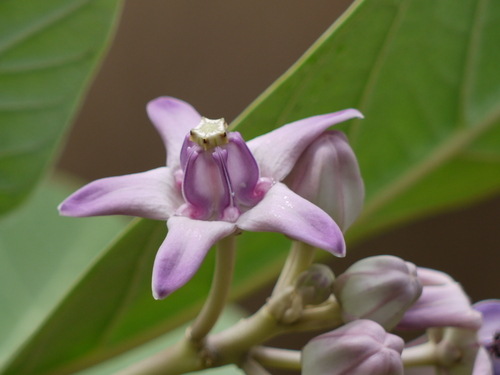
Calotropis gigantea (L.) W.T.Aiton has an erect, branched, cylindrical solid stem that contains milky latex. Its leaves measure 100–200 mm (4–8 in) long, are arranged oppositely in decussate pairs, shaped obovate or elliptic-oblong, with a shortly pointed tip, are nearly stalkless, and have a heart-shaped or often stem-clasping (amplexicaul) base. Its inflorescences are umbellate cymes. The flowers are large, white, and unscented, with peduncles that grow between the petioles. Flower buds are ovoid and angled. The calyx has 5 lobes, divided all the way to the base, are white and ovate. The corolla is broadly flattened (rotate) and valvate in bud, with 5 deltoid ovate reflexed lobes; its coronal appendages are broad, with two blunt auricles below the rounded apex, which sits lower than the staminal column. It has 5 stamens, with short anthers that have membranous appendages bent inward over the depressed apex of the pentagonal stigma. There is one pollinium per anther cell, with slender pendulous caudicles. It has two distinct carpels, two styles that unite into a single pentangular stigma, a 2-celled ovary, and many ovules. The fruit forms as a pair of follicles containing numerous hairy seeds. It flowers and fruits from November to April. This species acts as a host plant for a variety of insects and butterflies, including Hawaii's non-migratory monarch butterflies. It is pollinated via entomophily (pollination by insects), most commonly by bees. Calotropis has a gynostegium, a structure formed by the fusion of the stigma and androecium. Its pollen is grouped into structures called pollinia, which are attached to a glandular, adhesive disc at the stigmatic angle via the translator mechanism. When bees visit the flower, these sticky discs attach to the bees' legs; as the bee moves away, it pulls the pollinia out of the original flower. When the bee carrying the pollinia visits another flower, pollination can occur. Extracts from this plant's latex have been used as arrow poison in Africa. Arrow poisons are applied to arrows or spears to aid in hunting prey, and are commonly derived from plants in the family Apocynaceae, which includes Calotropis gigantea and the more potent Calotropis procera. Species in Apocynaceae, including this one, typically contain a mixture of cardiac glycosides, specifically calactin, uscharin, calotoxin, and calotropin. These toxins work by inhibiting the sodium-potassium pump, an effect that is particularly potent in cardiac tissue. While cardiac glycosides like those from digitalis have been used for heart medication, excessive doses can cause arrhythmia that leads to death. Calotropis gigantea is a poisonous plant, with active toxic principles being uscharin, calotoxin, calactin, and calotropin. Incising its leaves and stem releases a thick milky juice. Aside from its use as arrow poison, it has also been used as cattle poison, and is rarely involved in suicide or homicide poisoning; most cases of human poisoning from this plant are accidental. Exposure to the milky latex sap of Calotropis gigantea is known to cause toxic keratoconjunctivitis and reversible vision loss. This condition, called crown flower keratitis, is rare and usually occurs when the sap accidentally contacts the eye. It can happen during the process of making Hawaiian lei flower necklaces, when a person touches the sap then touches the surface of their eye. Poisoning damage to the corneal endothelium leads to corneal stromal edema and decreased visual acuity. While some permanent damage to the corneal endothelium remains, with decreased endothelial cell count and irregular cell shape, the remaining endothelial cells usually allow for full resolution of corneal edema and a return to normal visual acuity. The condition is generally self-limited, and resolves more quickly with topical steroid treatment. Its clinical course shows that Calotropis latex is relatively nontoxic to the corneal epithelium, but highly toxic to the corneal endothelium. Its typically painless course may be linked to anesthetic properties of the latex and relatively minor injury to the epithelium. The flowers of Calotropis gigantea are long lasting, and in Thailand they are used for floral arrangements. Preclinical studies have found that extracts from the flowers and leaves produce a hypoglycemic effect. Hawaiian Queen Liliuokalani favored these flowers, viewing them as a symbol of royalty and wearing them strung into leis. In Cambodia, flowers are used in funerals to decorate urns or sarcophagi, and the interior of the house holding the funeral. Its dry fruit releases seeds that are dispersed by wind. In Indonesia, the flowers are called widuri. According to the Shiva Purana, the madar (crown) flower is greatly favored by Lord Shiva, so crown flowers and their garlands are offered to Lord Shiva to pray for peace, prosperity, and social stability. The crown flower is also one of the main components of the nine astrological Navagrah trees. Calotropis gigantea produces a durable fiber, commercially known as bowstring of India, that is used to make ropes, carpets, fishing nets, and sewing thread. Floss obtained from its seeds is used as stuffing, and crown flower cotton can be used to make pillows. A fermented mixture of Calotropis and salt is used to remove hair from goat and sheep skins; goat skin processed this way produces nari leather, while processed sheep skin makes leather commonly used for inexpensive book binding. Calotropis has been reported to have stronger fungicidal properties than ointments, and also has insecticidal properties. In India, the plant is commonly found in temple compounds; it is called madar in Hindi (मदार), its leaf is called rui in Marathi, and it is one of the five leaves used in the Panch Pallava, a ritual assortment of five different leaves used as a totem in Maratha culture. Due to the potent bioactivity of calotropin, Calotropis gigantea has been used as a folk medicine in India for many years, with a wide range of reported uses. In Ayurveda, practitioners have used the root and leaf of closely related Calotropis procera to treat asthma, bacterial infections, inflamed red swelling, boils, and shortness of breath, and the bark to treat liver and spleen diseases. The plant is reported to be effective against skin, digestive, respiratory, circulatory, and neurological disorders, and has been used to treat fevers, elephantiasis, nausea, vomiting, and diarrhea. The milky juice of Calotropis procera has been used against arthritis and cancer, and as an antidote for snake bite. All these uses are documented folk uses, and more research is needed to confirm the clinical effectiveness of the leaves, latex, and bark. Recent studies have investigated calotropin as a contraceptive and as a potential cancer treatment. One study testing the anti-cancer properties of Calotropis gigantea found that DCM extracts from the plant were strongly cytotoxic against non-small cell lung carcinoma (A549), colon carcinoma (HCT 116), and hamster hepatocellular carcinoma (Hep G2). These extracts show potential as cancer treatments and warrant further clinical research.