About Calopteryx virgo (Linnaeus, 1758)
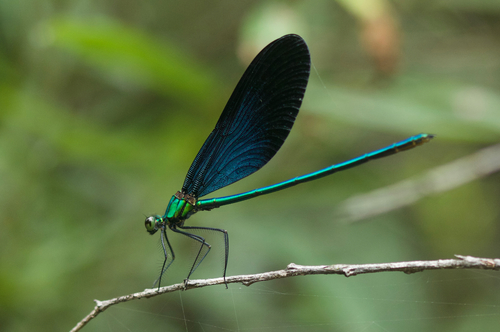
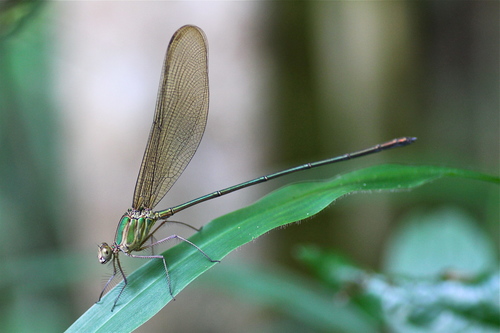
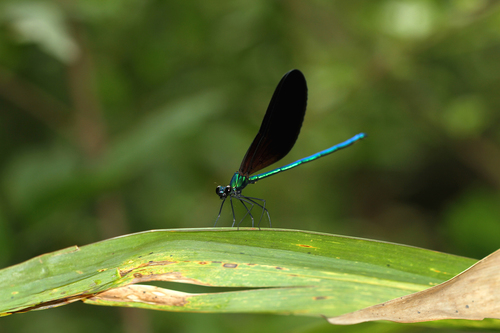
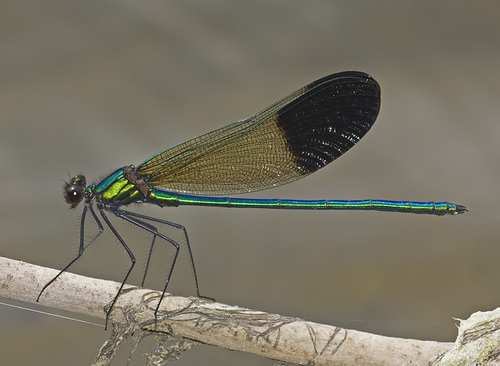
The beautiful demoiselle, scientifically known as Calopteryx virgo (Linnaeus, 1758), is a damselfly species in the family Calopterygidae. It has been recorded across Europe, North Africa, and Western Asia, and commonly occurs near fast-flowing waters. Across Europe, it is distributed throughout almost the entire continent, excluding southwestern Iberian Peninsula, the Balearic Islands, and Iceland. To the north, its range extends all the way to the Arctic Ocean, reaching much farther north than the banded demoiselle. Southern populations extend as far south as Morocco and Algeria. The eastern subspecies C. v. japonica found on the Japanese islands is currently a subject of debate over whether it qualifies as a separate species. Most beautiful demoiselle populations occur in lowland areas. Regular observations are recorded from areas up to 980 m above sea level; occasionally individuals can be found at altitudes up to 1,200 meters, for example in the Alps. The species’ larvae live in streams, and rely heavily on aquatic water plants. Larvae need plant stems and leaves to cling to, especially in areas with strong currents. As a result, larvae are extremely rarely found in barren locations, flat eroding banks, or areas with a smooth stone floor. Beautiful demoiselle larvae also inhabit small natural lakes or ponds with limestone bedrock. They occupy quiet areas between alluvial leaves or exposed roots, and can be found growing on submerged plants including waterweed (Elodea sp.), water crowfoot (Ranunculus fluitans), and other submerged plants growing from a few centimeters to several decimeters below the water surface. Compared to banded demoiselle larvae, beautiful demoiselle larvae prefer quieter sections of water, because slower flow allows more effective oxygen absorption underwater. Larvae are only very rarely found in completely stagnant water, and reside mainly within vegetation. Water oxygen content is a key factor determining where beautiful demoiselles occur. Their larvae are far more sensitive to oxygen deficiency than banded demoiselle larvae, and require sufficient water oxygen saturation. Waters with high amounts of sediment and sludge do not make good larval habitat. Water temperature is another key factor for beautiful demoiselle larval occurrence. This species prefers cooler, shadier areas of water, with an optimal average summer temperature between 13 and 18 °C. When temperatures rise above 22 °C, researchers have observed larval injury and reduced egg hatchability. Some individual populations can adapt to consistently higher temperatures. Adult beautiful demoiselles live in habitats near the larval habitats of the species. Unlike adult banded demoiselles, beautiful demoiselle adults can be found in forest clearings, and are very rarely seen on the banks of larger ponds. The species uses trees and shrubs as resting sites, and often rests on tall herbaceous plants such as large nettle (Urtica dioica). Breeding habitats match the preferred larval habitat. Beautiful demoiselles prefer cool, shady waterways with a moderately to strongly strong current, near-natural vegetation, and a near-natural bank structure. These habitats are most often meadow and pasture streams, and only rarely forest streams. Riparian vegetation also acts as a windbreak for this species, because its broad wings make beautiful demoiselle more likely to be blown away by wind than other damselfly species.