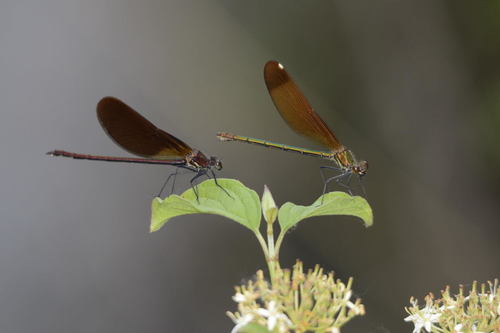
About Calopteryx haemorrhoidalis (Vander Linden, 1825)
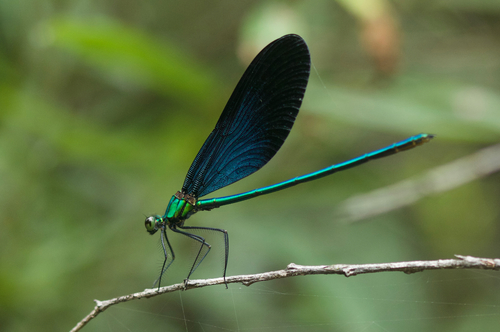
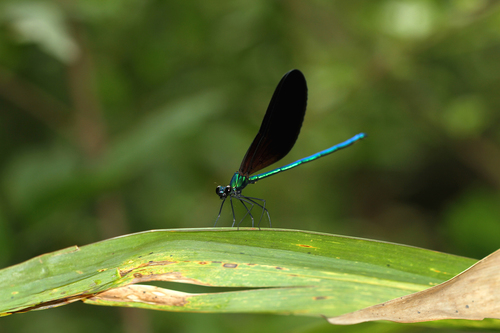
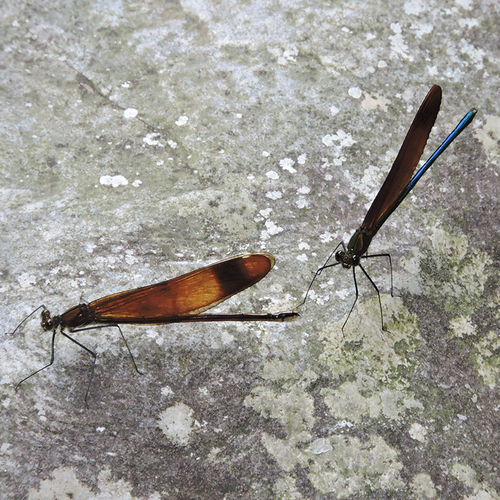
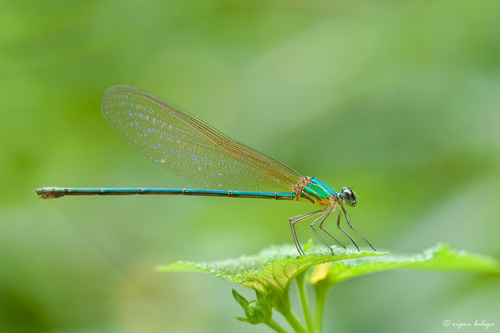
Calopteryx haemorrhoidalis, first formally described by Vander Linden in 1825, reaches an overall body length of approximately 45 to 48 millimeters (1.8 to 1.9 inches). Abdomen length differs slightly by sex: males have an abdomen 34 to 43 millimeters (1.3 to 1.7 inches) long, while female abdomens measure 31 to 43 millimeters (1.2 to 1.7 inches) long. Wing length also varies between sexes: male wings are 23 to 32 millimeters (0.91 to 1.26 inches) long, and female wings are 25 to 37 millimeters (0.98 to 1.46 inches) long. Males have a dark, metallic shiny body that can be red-violet, golden, or copper-colored. A distinct red area called the "red lantern" occurs on the underside of the last three abdominal segments; this feature gives the species its Latin name haemorrhoidalis, which means "blood flow". Male wings have a large dark area. Females have a brown band at the wing tip, a metallic-green to bronze-colored body, and a brown belt on the back. This species is native to the western Mediterranean Basin, found in Europe across Iberia, southern France, Italy, and Monaco, and in North Africa across Algeria, Morocco, and Tunisia. It is common across most of its native range. It inhabits areas along rivers and streams, and can also be found in sunny larger bodies of water. Populations of this species may be negatively impacted by habitat changes including water pollution.