About Calopogon tuberosus (L.) Britton, Sterns & Poggenb.
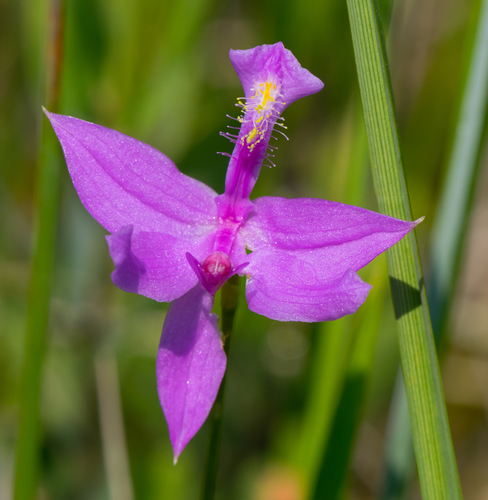
Calopogon tuberosus (L.) Britton, Sterns & Poggenb. can be identified by two key features: prominent hairs on its petal lip, often called "the beard", and the scent its flowers produce. Each individual plant grows one, occasionally two, linear basal leaves. Its flowers are most often magenta or pink, and rarely white, with a distinctively oblong-elliptic shaped middle petal. Unlike most other orchids, the flowers of this species grow upside down. The average maximum root depth of this species is 7 centimeters, or approximately 2.75 inches. In the United States, Calopogon tuberosus ranges from Texas and Oklahoma in the southwest, to the Florida Everglades in the southeast, as far north as Maine in the northeast, and to Minnesota in the northwest. In Canada, it grows in every province from Newfoundland to Manitoba. It can also be found in St. Pierre & Miquelon, Cuba, and the Bahamas. Between April and September, this species can be found in sandhill seeps, floating peat mats, savannas, fens, bogs, pine flatwoods, and marl prairies. Calopogon tuberosus does not produce nectar, but is still pollinated by bumblebees. When a bumblebee searches for nectar that does not exist, its weight pushes down the hinged lip of the flower, forcing the bee into contact with the flower's sticky pollinarium. The bee then carries the pollinarium away to pollinate another orchid when it visits.