About Calopogon multiflorus Lindl.
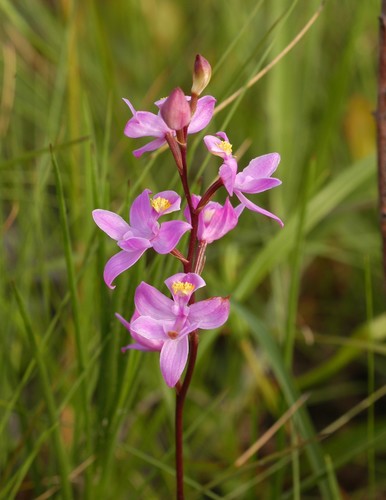
Calopogon multiflorus Lindl. has several distinct morphological traits: a dark purple rachis, a forked corm, pandurate lateral petals, and elongated, acuminate floral bracts that measure 0.3–0.8 cm by 0.3–0.5 cm. At peak anthesis, its flowers produce a pungent fragrance. After sprouting in early spring, one or sometimes two leaves grow clasping the bloom stem. A single stem can bear anywhere from 1 to 15 flowers. As flower buds mature, they open in quick succession; sometimes all flowers open in as little as two days. The flowers remain open for a couple of days before withering and falling to the ground. The flowering season of this species runs from March to May, with an average peak flowering time of mid-April in Louisiana. It grows ideally in conditions of full sun to light shade. Calopogon multiflorus is distributed across the southeastern United States. It occurs mainly in Florida, and can also be found in Alabama, Georgia, Mississippi, Louisiana, North Carolina, and South Carolina. According to NatureServe, this species is classified as imperiled or critically imperiled throughout its entire range, and it may be extirpated from Georgia. This species grows in dry to moist flatwoods that contain wiregrass, longleaf pine, and saw palmetto. It also inhabits mesic pine savannahs located on flat or gently sloping terrain. These longleaf pine savannas were once widespread across southeastern North America, and historically burned naturally at least once every ten years. Large areas of this species' suitable habitat have been lost due to logging and fire suppression. The soils where Calopogon multiflorus grows are usually sandy to loamy and acidic. Common neighboring species in its habitat include blackjack oak (Quercus marilandica), little gallberry/ink berry (Ilex glabra), slender bluestem (Schizachyrium tenerum), little bluestem (S. scoparium), and savannah meadow beauty (Rhexia alifanus). Across most of its range, this species does not grow in wet savannahs and bogs that host pitcher plants, though one Louisiana location supports populations that coexist with pitcher plants. Calopogon multiflorus requires prescribed annual winter fires to appear, a trait it shares with many pine savanna understory plants. It typically blooms 6 to 8 weeks after a burn, and likely benefits from reduced competition with other plants and nutrients released during the fire. For pollination, this species falsely lures bees with a false promise of pollen that it does not provide. The flower's beard is structured to trick visiting insects: when an insect lands on the beard, the lip of the beard swings downward like a hinge on a hinge. This movement presses the insect's head and back against the flower's column. If the insect does not already carry pollen, it will pick up a load of pollinium; if the insect already carries a pollinium load on its back, the movement will place the pollinium onto the flower's stigma.