About Calophyllum brasiliense Cambess.
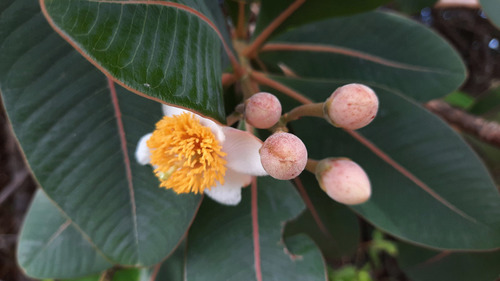
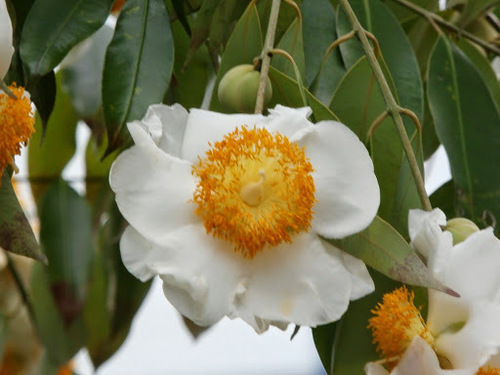
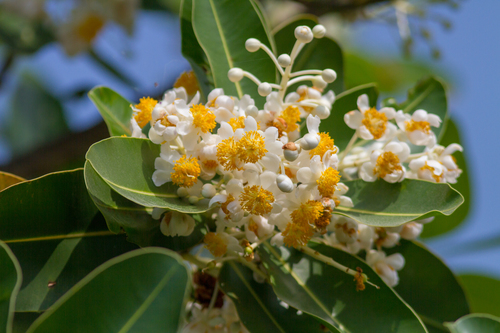
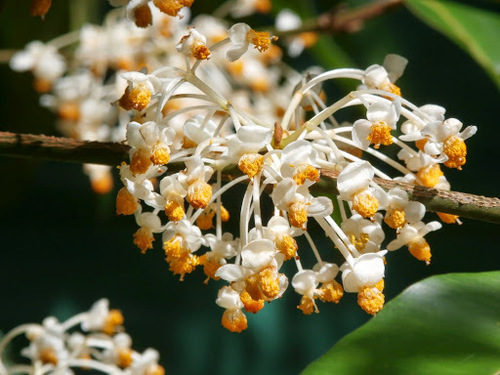
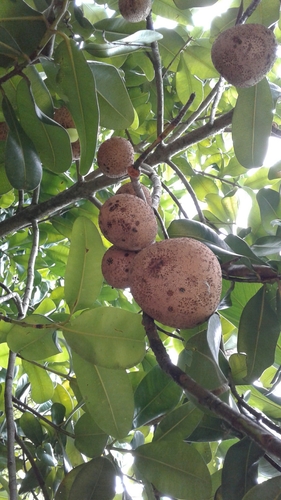
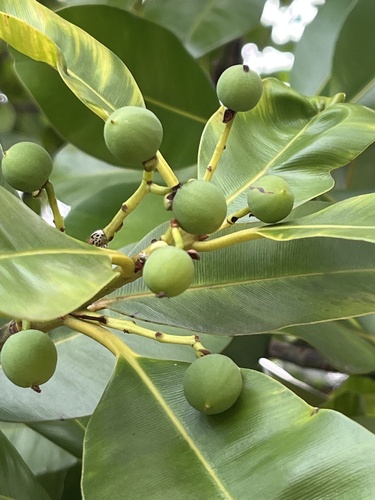
Calophyllum brasiliense Cambess. is an evergreen tree that reaches 20–50 m in height, with a trunk up to 1.8 m in diameter and a dense, rounded crown. Its leaves are opposite, 6.3–12.5 cm long and 3.2–6.3 cm wide, with shapes ranging from elliptic to oblong or obovate. The leaves are leathery, hairless, glossy green on the upper surface, paler on the lower surface, and have an entire margin. Its flowers measure 10–13 mm in diameter, with four white sepals (two larger and two smaller), and 1 to 4 white petals smaller than the sepals. Flowers are grouped in panicles 2.5–9 cm long. The fruit is a globular drupe 25–30 mm in diameter. This species is very common across Brazil, ranging from Santa Catarina to Pará, and also grows in the Pantanal and the Amazon forest. It is also common in Paraguay, Peru, Bolivia, Colombia, Venezuela, Mexico, Belize, Guatemala, Nicaragua, Costa Rica, Panama, Puerto Rico, Trinidad and Tobago, the Dominican Republic and Cuba. It grows at elevations between sea level and 1200 meters, and frequently forms pure stands, a capacity that is uncommon among tropical hardwood trees. Its natural dispersal is carried out by water, fishes, monkeys, and mainly by bats. The common name "guanandi" comes from the Tupí language of Indigenous peoples of Brazil, and it means "soap that glues". This name refers to the yellow latex (balsam) from the bark, which contains the compound Jacareubin. This species has documented medicinal uses: it is used to treat ulcers and gastritis, prevent prostate damage, aid skin scarification, and treat sunburn. It is also used to control molluscs that transmit the Chagas disease parasite. American and Asian universities are currently studying its effects on reducing cancer tumors. Terracom labs, in a joint venture with Sarawak Medichen in Indonesia, hold a patent for the use of Calanolide A and Calanolide B — compounds found in the latex and leaves of this Calophyllum species — as AIDS inhibitors. Oil from this species, known as tamanu oil, is used in the cosmetic and dermatological industries for skin cleansing, reducing skin wrinkles, and caring for skin after tattooing. The fruit is composed of 44% oil, which can be burned as biofuel. There are dozens of historical records of the active properties of calophyllum oil, from pre-Columbian Incas and Aztecs in Latin America, to peoples in Asian and Polynesian Islands. Its timber has very high chatoyance, with an average value above 23 PZC. Replacing unsustainably harvested native Amazon trees with cultivated guanandi has been proven very beneficial for protecting these important biomes. Unlike mahogany, guanandi forms pure stands. Cutting and transporting a single wild mahogany in the Amazon requires destroying 30 additional trees. This substitution is possible because conscious buyers from Europe, Japan, and the United States are beginning to understand the importance of Amazon Forest conservation, and are willing to pay more for wood from reforested sources. Other valuable tropical timber species cannot be harvested commercially because they are attacked by the caterpillar Hypsipyla grandella Zeller, which destroys the main structure of host trees including South American mahogany (Swietenia macrophylla), Brazilian cedar (Cedrela fissilis), and crabwood (Carapa guianensis). Growing guanandi also offers benefits to forested areas. The root system of guanandi raises the water table, and restores and fertilizes the soil where it is planted. Guanandi and other fast-growing high-quality timber species are very promising important commodity crops. In cities in São Paulo state, southeastern Brazil, there are guanandi plantations with around one million planted trees. Guanandi tree farms in UNA, southern Bahia state, have already started commercial production.