About Calophasia platyptera Esper
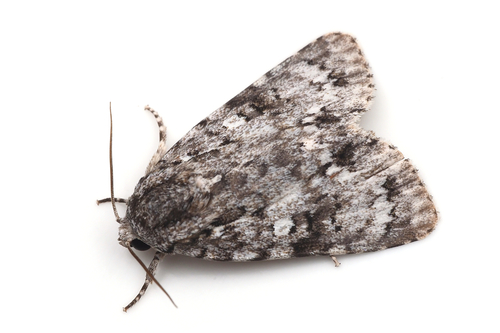
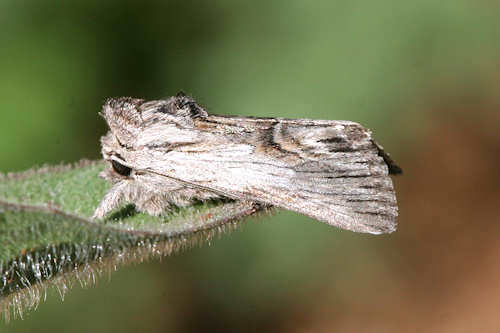
Calophasia platyptera Esper, also referenced by the synonyms canterius Vill. and tenera Hbn. The forewing is pale grey with minor scattered darker dusting, and veins are finely dark. A thin black streak runs along the submedian fold starting from the base, crossing the faintly paler claviform stigma. Lines on the forewing are marked by oblique costal strigae and double curved marks on the inner margin; on the inner margin, the outer line is preceded by a curved dark grey cloud. The terminal area has a double row of black streaks in the wing intervals, interrupted by a pale submarginal line, and the fringe is checkered fuscous and grey. The hindwing is dull dingy grey in females and whitish in males: the terminal half is fuscous in females, while it forms only a narrow grey border in males.
The aberrant form ab. subalbida Stgr., which Stgr. questioned might only represent the summer brood, occurs in Sicily and Algeria. This form is much whiter than the base species, with the dark markings of the forewing becoming indistinct, and the hindwing is almost entirely white. The form olbiena Dup. has the dark markings on the forewing intensified, appearing blackish brown.
The larva resembles the larva of Calophasia lunula: it is whitish with yellow lines and transverse black blotches. In this species, the black blotches are smaller and more numerous, and the yellow lines are more interrupted at the segmental incisions. The wingspan of this moth is approximately 30 mm.