About Calogaya pusilla (A.Massal.) Arup, Frödén & Søchting
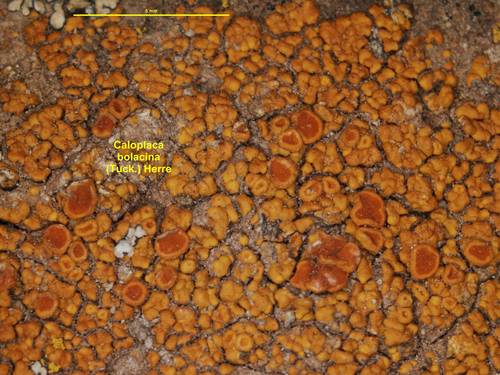
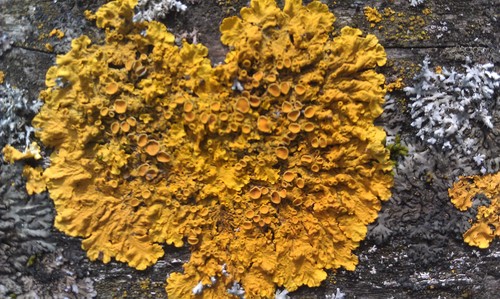
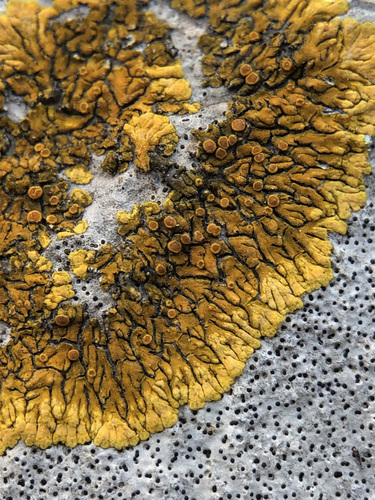
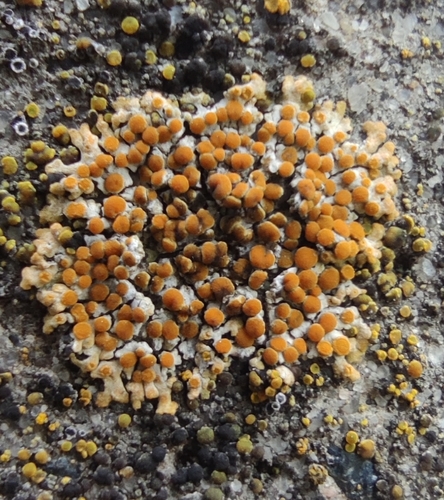
Calogaya pusilla is a small but visually striking lichen that forms neat, rosette-shaped growths 1–3 centimetres in diameter. Its thallus, the main body of the lichen, ranges in color from yellow to orange, occasionally with a pinkish tint, and grows tightly attached to its growing surface. Along its outer edge, the lichen produces short, broad, flattened lobes roughly 2 mm long and 1.5 mm wide. These lobes are usually convex and swollen, giving them a plump look, and may be split by small furrows. A distinct characteristic of this species is that its lobe surfaces often have a white, powdery coating called pruina. The central area of the lichen is made up of convex granules, which are often hidden by numerous apothecia, the lichen’s fruiting bodies. These disc-shaped apothecia can grow up to 1.0 mm in diameter, and are typically densely packed in the central part of the lichen. When young, each apothecium has a flat, orange to brownish-orange disc surrounded by a clearly visible yellow to orange rim, called an exciple. As the apothecium matures, its disc becomes convex and its rim becomes less prominent. Microscopic examination of the spore-producing structures shows additional identifying traits. The tips of the sterile filaments called paraphyses inside the apothecia are swollen, measuring 6–8 micrometres (μm) in diameter. The spores, or ascospores, are ellipsoidal, measuring 10–15 μm long by 5–7 (occasionally 8) μm wide, with a cross-wall (septum) 2–4 μm thick that makes up roughly one-fourth to one-fifth of the spore’s total length. When tested with potassium hydroxide solution (K), both the thallus and apothecia turn purple, which is an important chemical characteristic for identifying this species.