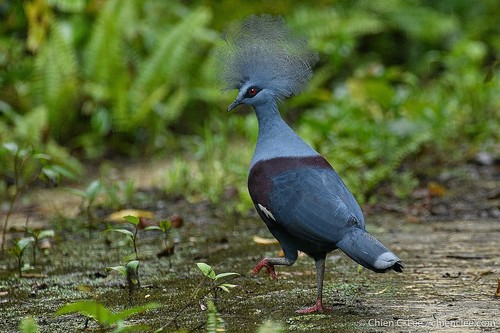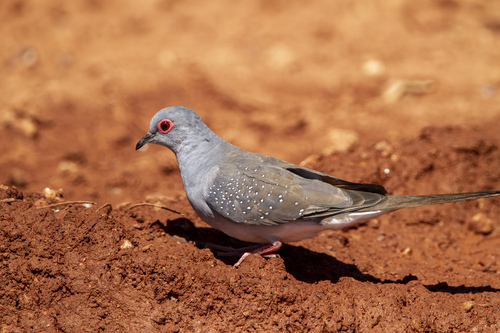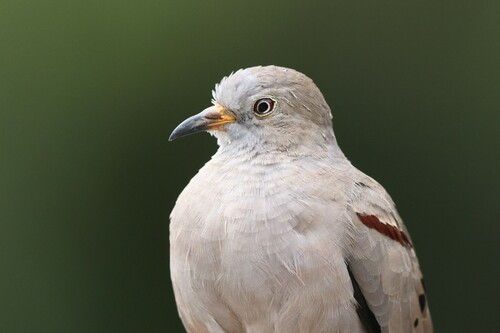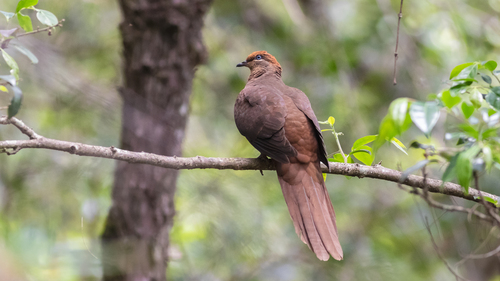
About Caloenas nicobarica (Linnaeus, 1758)
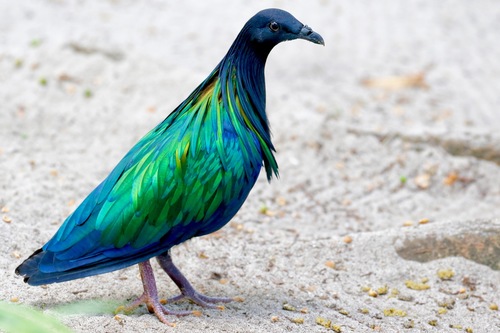
Caloenas nicobarica, the Nicobar pigeon, is a large pigeon that measures 32–35 cm (13–14 in) in length. Its head and upper neck plumage are grey, and the upper neck transitions into green and copper hackles. It has a short, solid pure white tail. The rest of its plumage is metallic green, which appears black in low, dull light. The cere of its dark bill forms a small blackish knob; its strong legs and feet are dull red, and its irises are dark. Females, which weigh 490–600 g, are on average slightly larger than males, which weigh 460–525 g, though size ranges overlap greatly. Females also have a smaller bill knob, shorter hackles, and browner underparts. Immature birds have a black tail and almost no iridescent plumage. There is very little physical variation across the species' entire wide range. Even the Palau subspecies C. n. pelewensis differs only by having shorter neck hackles, and is otherwise nearly identical to the main species. This is a very vocal species that produces a low-pitched repetitive call. The species takes its common and scientific names from the Nicobar Islands, where the largest modern colony of Nicobar pigeons is located on Batti Malv, a remote wildlife sanctuary between Car Nicobar and Teressa. The 2004 Indian Ocean tsunami caused extensive damage across the Nicobar Islands, and the full extent of damage to Batti Malv remains unclear. While entire islets in the Great Nicobar Biosphere Reserve were completely destroyed, the 12-meter tall skeletal lighthouse on Batti Malv, which stands just a few meters above sea level at the low-lying island's highest point, sustained very little damage and was returned to operation by the survey ship INS Sandhayak less than one month after the disaster. An April 2007 survey conducted by the Indian Coast Guard vessel ICGS Vikram found the lighthouse tower completely covered in vines, indicating rapid vegetation regrowth. This vine cover may also signal that the island's forest sustained severe damage, because creeping plant cover is typical for early ecological succession; photos of the lighthouse taken before the tsunami show mature forest growing on the island. The Nicobar pigeon's breeding range covers the Andaman and Nicobar Islands of India, the Mergui Archipelago of Myanmar, offshore islands of south-western Thailand, Peninsular Malaysia, southern Cambodia and Vietnam, and many small islands between Sumatra, the Philippines, and the Solomon Islands. The only distinct subspecies, C. n. pelewensis, is found on Palau. Nicobar pigeons roam in flocks across different islands, typically sleeping on predator-free offshore islets and spending the daytime in areas with better food access, and do not avoid areas inhabited by humans. Their diet consists of seeds, fruit, and buds, and they are attracted to areas where grain is available. They use a gizzard stone to grind up hard food items. Their flight is quick, with regular wing beats and occasional sharp wing flicks, which is typical of most pigeons. Unlike other pigeons, Nicobar pigeon groups fly in columns or single file, rather than as loose flocks. The prominent white tail, which is visible from behind during flight, may act as a taillight to help flocks stay together when crossing the sea at dawn or dusk. Young birds' lack of a white tail acts as a clear signal of immaturity to other members of the species. Adult Nicobar pigeons can immediately tell which flock members are not potential mates, not competitors for mates, and not old enough to safely guide a flock between islands. When traveling between islands, the species typically flies high, at least 60 meters above the sea surface. This species nests in dense forest on offshore islets, often in large colonies. It builds a loose stick nest in a tree and lays one elliptical, faintly blue-tinged white egg. In 2017, multiple individual Nicobar pigeons were sighted in the Kimberley region of Western Australia, and a juvenile was captured at Ardyaloon (One Arm Point) near Broome. This marks the first time the species has been sighted on the Australian mainland.