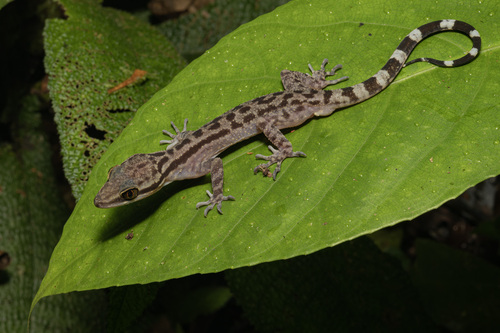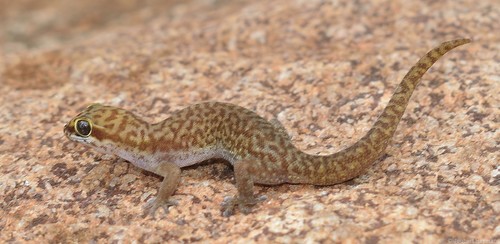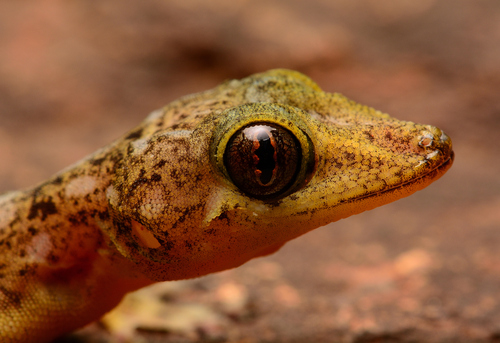
About Calodactylodes aureus (Beddome, 1870)
Digits Base and Underside Scales
This species has digits that are slender at the base and free, with squarish scales on their underside.
Digital Expansions
Each digit has large trapezoidal penultimate and distal expansions; the lower surface of each expansion is covered by two large plates separated by a longitudinal groove.
Digit Claws
All digits bear a claw, and the claw is retractable between the distal plates. The penultimate expansion is absent on the inner digit.
Body Surface Scales
The upper surface of the body is covered in small granular scales mixed with larger tubercles, and abdominal scales are positioned next to one another without overlapping.
Pupil Shape
Pupils are vertical.
Pore Presence
No preanal or femoral pores are present.
Head General Shape
The head is large, oviform, and very distinct from the neck.
Supraorbital and Canthal Ridge
A strong, rounded supraorbital and canthal ridge is present.
Head Concavities
There are five deep concavities: one frontal, two postnasal, and two loreal.
Snout Length
The snout is longer than the distance between the eye and ear opening, measuring 1.3 times the diameter of the orbit.
Ear Opening
The ear opening is vertical and measures half the diameter of the eye.
Body Depression
The body is not strongly depressed.
Limb Morphology
Limbs are long and slender.
Digital Expansion Width
The width of the digital expansion is about half the diameter of the eye.
Head Upper Surface Scales
The head is covered in very small granules, which are largest on the canthal ridges.
Rostral Scale
The rostral scale is four-sided, twice as broad as high, and has a concave posterior border.
Nostril Position
Nostrils are located between the rostral, the first labial scale, and three nasal scales.
Anterior Nasal Scale
The anterior nasal is large and contacts the opposite anterior nasal.
Labial Scales Count
There are 12 or 13 upper labials, and the same number of lower labials.
Mental Scale
The mental scale is the same size as the adjacent labials, or smaller.
Chin and Gular Scales
There are no regular chin-shields; small, polygonal scales gradually transition into the granules that cover the gular region.
Upper Body Granular Scales
The upper body surface is covered in minute granules.
Dorsal Tubercles
The back has scattered, barely prominent, smooth, round larger tubercles that are not as large as the ventral scales.
Ventral Scales
Ventral scales are flat, smooth, squarish, juxtaposed, and arranged like bricks in a wall.
Tail Morphology
The tail is long, cylindrical, remarkably slender, and covered in squarish scales that are much larger on its underside.
Upper Surface Coloration
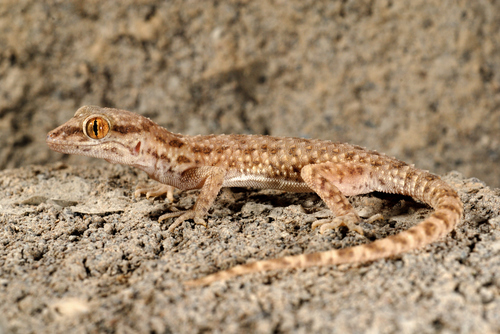
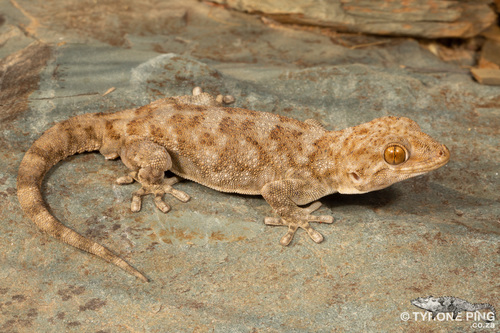
In preserved specimens, the upper surface color is brownish-white; it is golden during life, and dotted or vermiculated with brown.
Lower Surface Coloration
Lower surfaces are whitish.
Size Measurements
The species measures 3.5 inches (8.9 cm) from snout to vent, and the tail is 3.2 inches (8.1 cm) long.
Country Distribution
This species is found only in India, where it is restricted to rocky areas of the Eastern Ghats.
Habitat Specifics
It occurs among rocks in dark, shady ravines in the Tirupati Hills, according to M.A. Smith 1935.
Reproduction and Nesting
Mature females deposit more than 300 eggs into a shared community nest located near water or moist areas.