About Calochortus gunnisonii S.Watson
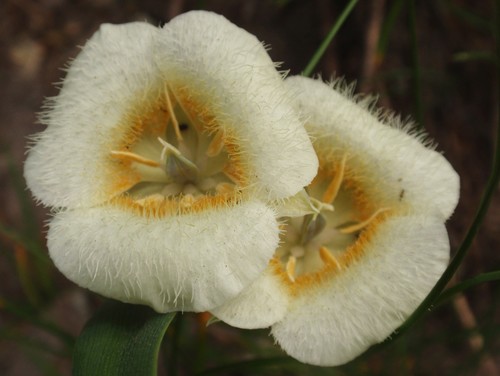
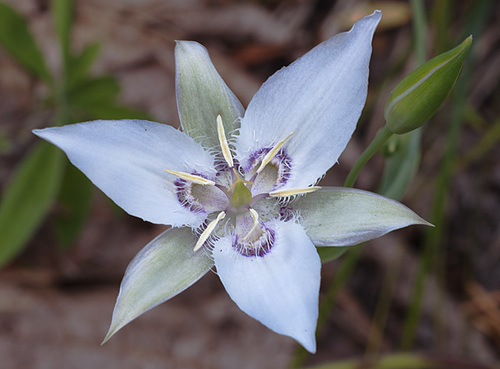
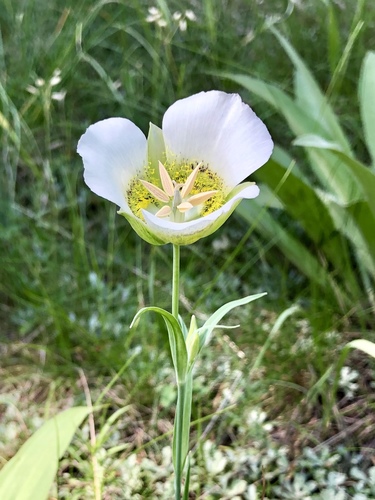
Calochortus gunnisonii S.Watson, commonly called the Rocky Mountain mariposa or Gunnison mariposa lily, is a North American flowering plant species belonging to the lily family. It is native to the western United States, found primarily in the Rocky Mountains and Black Hills, with documented populations in Arizona, New Mexico, Utah, Colorado, Wyoming, Montana, South Dakota, Grant County in Washington state, Sioux County in northwestern Nebraska, and Fremont County in eastern Idaho. This is a bulb-forming perennial herb that produces straight stems reaching up to 55 centimeters in height. Its flowers range in color from white to purple, with darker purple markings. The three petals have a wide rim above a deeply concave inner section that is lined with hairs. Between and behind each broad petal are three narrow, lanceolate sepals. Two varieties of this species are recognized: Calochortus gunnisonii var. gunnisonii, which occurs across most of the species' full range, and Calochortus gunnisonii var. perpulcher Cockerell, found in New Mexico. This varietal taxon, also called the Pecos mariposa lily, is an uncommon yellow-colored form restricted to Colfax, Mora, and San Miguel counties in New Mexico. In cultivation, the Rocky Mountain mariposa is valued by gardeners in the American prairies and intermountain west for the elegant appearance of its deeply cupped flowers with recurved edges. While the species can successfully bloom and propagate outside of its native range, it is closely adapted to the dry conditions of western plains and mountains. Gardeners in wet climates must take careful precautions to protect the plants from excessive moisture in all seasons, especially winter. A 10 to 15 centimeter deep layer of gravel is often placed approximately 6 centimeters below the bulbs to improve drainage. This plant requires well-draining, fine textured soil that is not overly sandy and contains little organic matter. Bulbs are planted 10 centimeters deep, and individuals can live up to 30 years when grown in favorable climates.