About Calocephalus citreus Less.
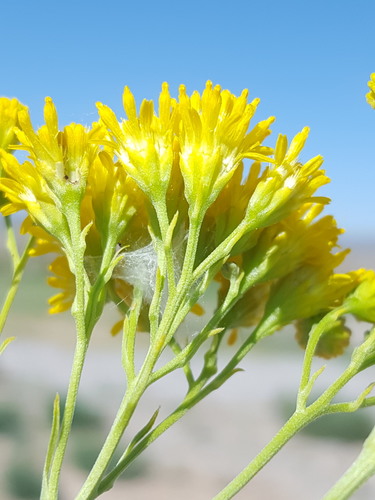
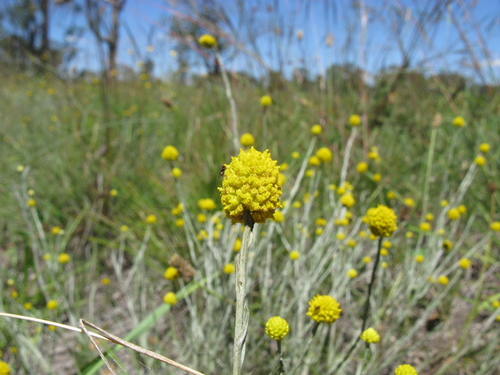
Calocephalus citreus Less. is a perennial herb. It has upright, slender, light grey, fuzzy, slightly angular stems that reach 15 to 60 cm (5.9 to 23.6 in) in height. Its leaves are typically arranged oppositely, with shapes ranging from linear to lance-shaped. Most leaves measure 10–20 mm (0.39–0.79 in) long and 1–2 mm (0.039–0.079 in) wide, and are covered in short, dense, matted hairs, with prominent visible veins. Flower heads grow singly, and are oblong to globose in shape, measuring 0.4–2 cm (0.16–0.79 in) long. These heads are lemon-coloured when in bud, and turn bright yellow when flowering. Each head holds 8 to 11 bracts that are flat and folded lengthwise, 1.9–3.4 mm (0.075–0.134 in) long, and contains 2 to 3 florets per head. Flowering occurs from September through March. The fruit is a cypsela 0.7–0.85 mm (0.028–0.033 in) long, brown in colour, with its upper surface covered in fine, feathery bristles. Common name lemon beauty-heads, this species grows in low-lying areas within herbfields, dry forest and grassy woodland, and occurs in the eastern states of Australia and the Australian Capital Territory.