About Calocedrus decurrens (Torr.) Florin
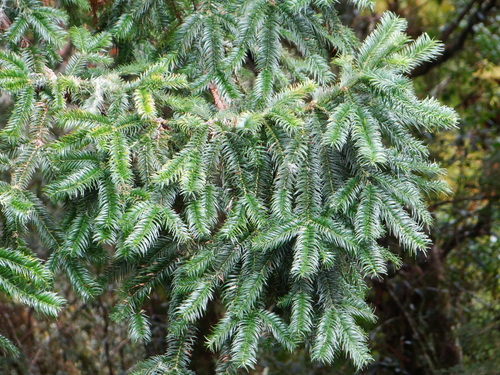
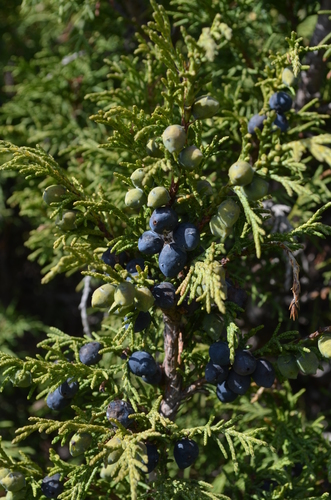
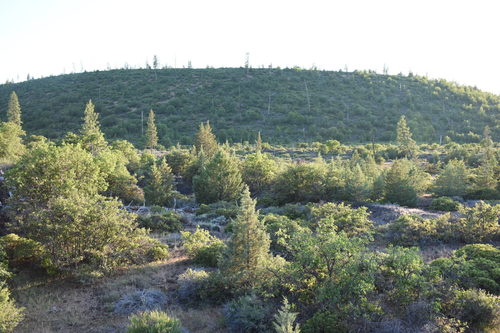
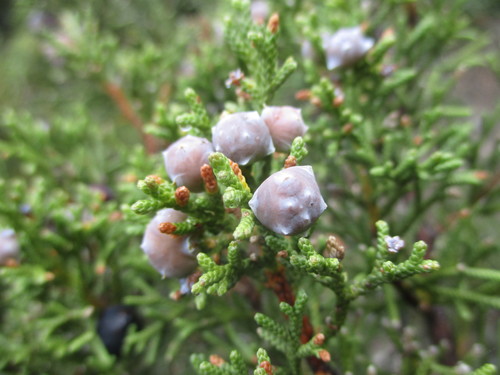
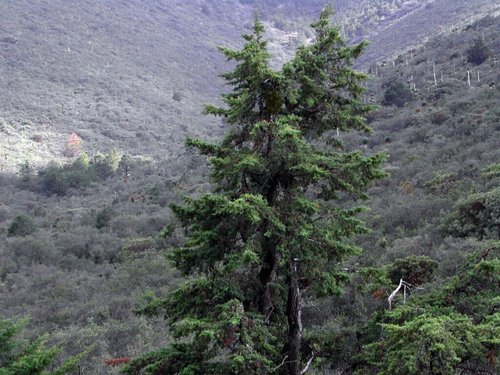
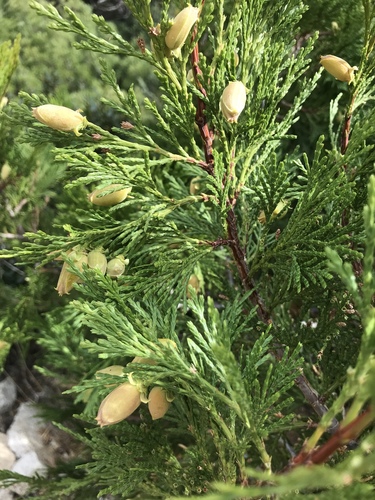
Calocedrus decurrens (Torr.) Florin is a large tree, typically growing 30 to 40 meters (100–130 ft) tall with a trunk diameter up to 1.2 meters (3 ft 11 in). The largest known individual grows in Klamath National Forest, Siskiyou County, California, and reaches 47.98 meters (157 ft 5 in) tall, with a 12-meter (39 ft 4 in) trunk circumference and a 17.5-meter (57+1⁄2 ft) crown spread. Mature specimens develop a broad conical crown made of spreading branches. Its bark is orange-brown, fading to a grayish tone with age; it starts smooth, then becomes fissured and peels in long strips on the lower trunk of old trees. Individuals can live for over 500 years. Its foliage grows in flattened sprays, bearing scale-like leaves 2–15 mm (3⁄32–19⁄32 in) long. Leaves are arranged in opposite decussate pairs: successive pairs alternate between close and wide spacing, creating the appearance of four-leaf whorls. The facial pairs of leaves lie flat, while the lateral pairs fold over their bases. Leaves are bright green on both sides of the shoots, with only faint, inconspicuous stomata. Crushed foliage gives off an aroma similar to shoe polish. Seed cones of this species are 20–35 mm (3⁄4–1+3⁄8 in) long, pale green to yellow when young, with four (rarely six) scales arranged in opposite decussate pairs. Each outer scale bears two winged seeds, while the inner pair(s) are usually sterile and fused into a flat plate. Cones ripen to orange or yellow-brown around 8 months after pollination. Pollen cones measure 6–8 mm (1⁄4–5⁄16 in) long. Most of the species' range is in the United States, stretching from central-southwestern Oregon through most of California, extreme western Nevada, and extends a short distance into northwestern Mexico, in northern Baja California. It grows at altitudes between 50 and 2,900 m (160–9,510 ft). At lower elevations, common associated tree species include oaks and ponderosa pine. Giant sequoia shares similarities with this species, but has sharp leaves. In the south-southwestern United States, some people have mistaken bushy junipers for incense cedar. Thanks to its thick basal bark, Calocedrus decurrens is one of the most fire- and drought-tolerant plant species in California. While hot stand-replacing crown fires kill the tree, it spreads quickly after lower-intensity burns, which has given it a competitive advantage over other species such as bigcone Douglas-fir in recent years. It is more shade tolerant than Douglas-fir, but less shade tolerant than grand fir or white fir, and grows slowly when this strategy is needed to outlast competing vegetation. This tree is the preferred host of the wood wasp Syntexis libocedrii, which lays its eggs in smoldering wood immediately after a forest fire. It is also host to incense-cedar mistletoe (Phoradendron libocedri), a parasitic plant that often hangs from its branches. Fire scars create an entry point for Tyromyces amarus, which causes pocket dry rot. The species can be affected by Gymnosporangium rust disease, but the infection is rarely fatal. During winter, many bird species forage on Calocedrus decurrens. The United States Department of Agriculture notes that in areas of California's Western Sierra Nevada, multiple bird species use incense cedar as a foraging substrate to access enough food. Human impacts from forest management practices have created problems for these birds, threatening their use of incense cedar as a foraging substrate. The wood of Calocedrus decurrens is soft and light, has a pleasant scent, and is generally resistant to rot. It has been used for external house siding, interior paneling, and to make moth-resistant hope chests. It was once the primary material used for wooden pencils, because it is soft and sharpens easily without forming splinters. Calocedrus decurrens is cultivated as an ornamental tree for planting in gardens and parks. It is used in traditional gardens, xeriscaping, native plant gardens, and wildlife gardens, as well as in designed natural landscaping and habitat restoration projects in California. It is valued for its columnar growth form and evergreen foliage texture. The tree is also grown in gardens and parks in cool summer climates, including the Pacific Northwest of the Northwestern United States and British Columbia, eastern Great Britain, and continental Northern Europe. In these regions, it often develops an especially narrow columnar crown, an unexplained effect of cooler climatic conditions that is rare for trees growing within its natural warm-summer range in the California Floristic Province. Other cultivated species in the Cupressaceae family can develop similar narrow crown forms.