About Caloboletus rubripes (Thiers) Vizzini
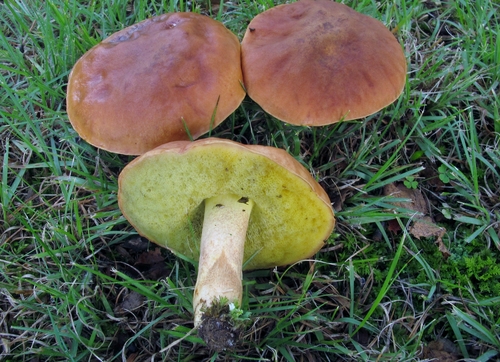
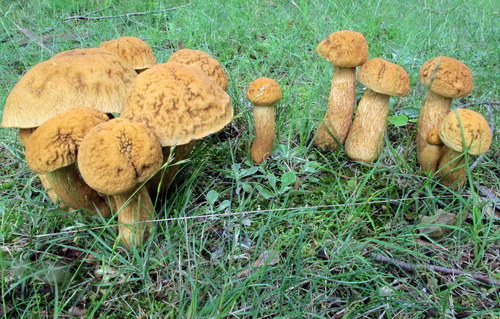
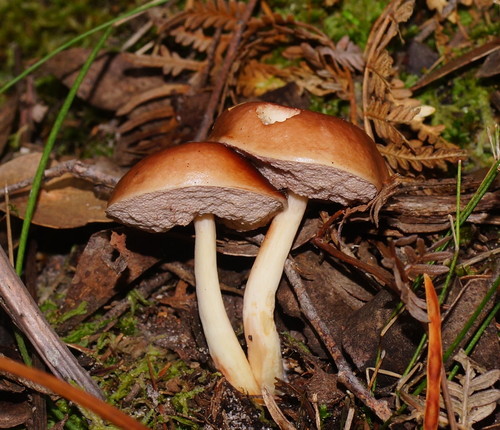
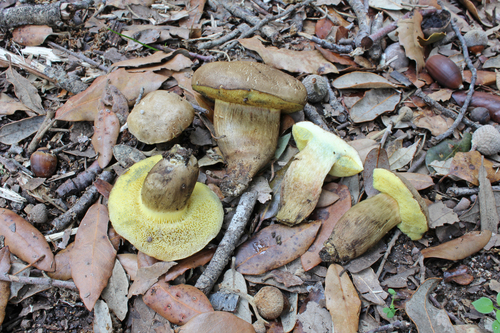
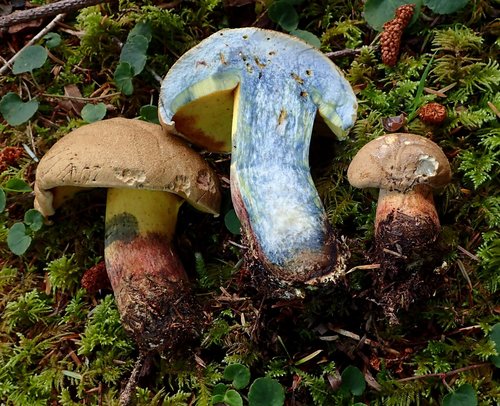
The fruit body of Caloboletus rubripes has a cap that starts convex to cushion-shaped, and flattens out when it reaches maturity, reaching diameters of 4–20 cm (1+5⁄8–7+7⁄8 in). The cap margin is rolled or curved inward, and stays this way until maturity. The cap surface is dry, with a texture ranging from velvet-like to slightly hairy, and often develops cracks as it ages. Cap color is variable, ranging from buff to olive-buff to olive-brown, and it stains brown when bruised or injured. The flesh is whitish to pale yellow, and turns blue quickly when cut or exposed to air. The odor of the fruit body ranges from indistinct to unpleasant, and its taste is bitter. The pore surface on the underside of the cap is initially yellow, and turns olive-yellow with age; it turns blue instantly when bruised. The angular pores number about 1–3 per millimeter, and the tubes that make up the hymenophore are 8–16 mm (3⁄8–5⁄8 in) long. The stem measures 5–15 cm (2–5+7⁄8 in) long by 2–5 cm (3⁄4–2 in) wide. It is either nearly equal in width along its length, club-shaped, or slightly tapered toward either end. The stem is solid, meaning it is not hollow, and has a dry surface with slight longitudinal grooves. Its color is pinkish-red to purple-red, except for a yellow region near the top and yellow mycelium at the base. The stem has neither reticulation nor a ring. Caloboletus rubripes produces an olive-brown spore print. Its spores are somewhat spindle-shaped to somewhat cylindrical, smooth, and measure 12–18 by 4–5 μm. The spore-bearing basidia are club-shaped, four-spored, and measure 26–30 by 7–13 μm. There are no clamp connections in the hyphae. Fruit bodies grow on the ground singly, scattered, or in clusters. They usually grow in coniferous forests, but can also grow in association with oak. This species is found in North America, with distribution covering the US Pacific Northwest region including Idaho, the southwestern United States, and Mexico, and is particularly common in New Mexico and Colorado. Fruit bodies typically appear in summer and fall. Alexander Smith has noted that they often grow alongside C. coniferarum and C. calopus. These mushrooms are inedible due to their bitter taste. They are used in mushroom dyeing to produce beige, light brown, or light golden brown colors, depending on the mordant used.