About Caloboletus calopus (Pers.) Vizzini
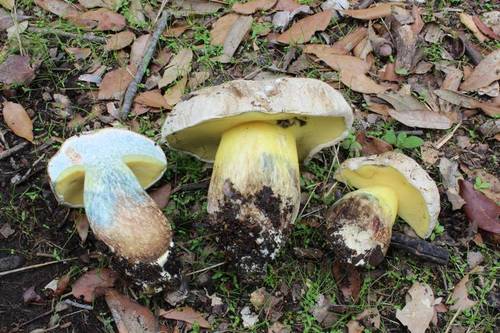
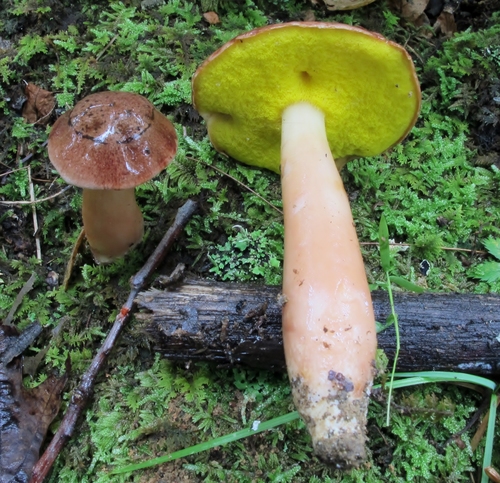
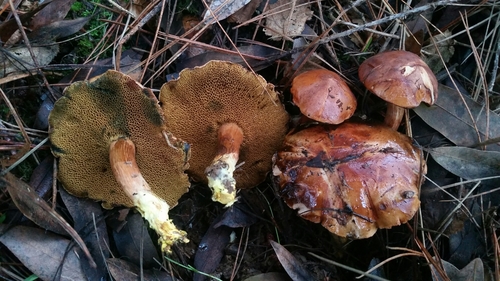
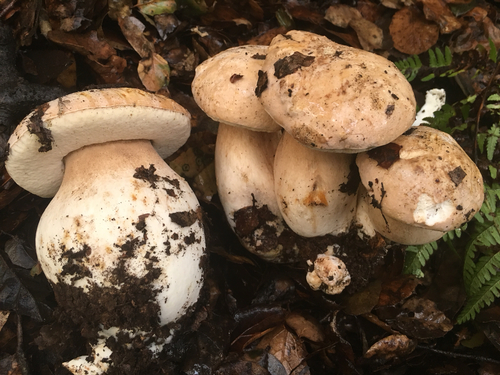
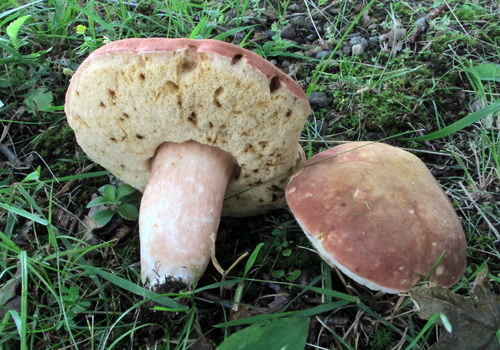
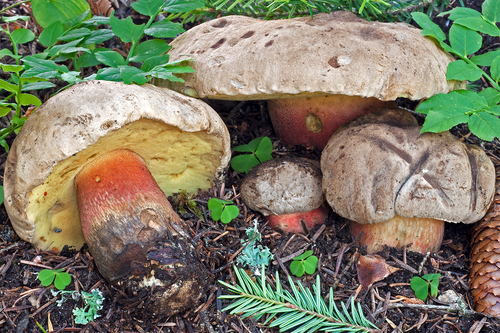
Caloboletus calopus has a cap that can reach up to 15 centimetres (6 inches) in diameter, and rarely grows as large as 20 cm (8 in) across. Its cap colour ranges from beige to olive, and it starts out nearly globular, then expands to become hemispherical before becoming fully convex in shape. The cap surface is either smooth or covered in tiny minute hairs, and may develop cracks as the mushroom ages. The cap cuticle extends past the edge of the cap. The pore surface is pale yellow when young, and deepens to an olive-yellow colour as the mushroom matures. It turns blue quickly when injured. There are one or two pores per millimetre; the pores are circular when young and become more angular as the mushroom ages. The spore-bearing tubes reach up to 2 cm (0.8 in) deep. The attractively coloured stipe is typically yellow in its upper section and pink-red towards the base, with a straw-coloured net-like reticulation covering the top or upper half of the stipe. Occasionally the entire stipe is reddish. The stipe measures 7–15 cm (2.8–5.9 in) long by 2–5 cm (0.8–2.0 in) thick, and is either roughly consistent in width along its length, or thicker towards the base. Sometimes the reddish stipe colour of mature mushrooms or harvested specimens that are a few days old disappears entirely, and is replaced by ochre-brown colouring. The pale yellow flesh stains blue when broken, with discolouration spreading out from the damaged area. It can have a strong smell, which has been compared to ink. The spore print of this species is olive to olive-brown. The spores are smooth, elliptical, and measure 13–19 by 5–6 μm. The spore-bearing basidia are club-shaped, four-spored, and measure 30–38 by 9–12 μm. The cystidia are club-shaped to spindle-shaped, hyaline, and measure 25–40 by 10–15 μm. Multiple varieties of Caloboletus calopus have been described. Variety frustosus is morphologically similar to the main type, but its cap becomes areolate, marked into small sections by cracks and crevices, when mature. Its spores are also slightly smaller, measuring 11–15 by 4–5.5 μm. In the European form ereticulatus, the reticulations on the upper stipe are replaced by fine reddish granules, while variety ruforubraporus has pinkish-red pores. Caloboletus calopus is an ectomycorrhizal species that grows in both coniferous and deciduous woodland, often at higher altitudes, and especially under beech and oak trees. Its fruit bodies grow either singly or in large groups. The species grows on chalky ground from July to December. It is found in Northern Europe, as well as the Pacific Northwest and Michigan regions of North America, with its North American range extending south to Mexico. Variety frustosus is known from California and the Rocky Mountains of Idaho. In 1968, after comparing European and North American collections, Miller and Watling suggested that the typical form of C. calopus does not occur in the United States. Similar comparisons carried out by other authors have led to the opposite conclusion, and the species has been included in multiple North American field guides since that time. This bolete has also been recorded from the Black Sea region in Turkey, under Populus ciliata and Abies pindrow in Rawalpindi and Nathia Gali in Pakistan, and in Yunnan Province in China, Korea, and Taiwan.