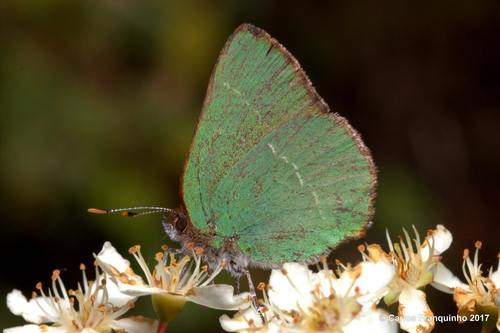
About Callophrys rubi (Linnaeus, 1758)
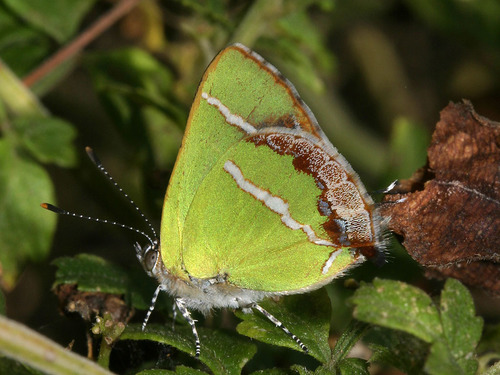
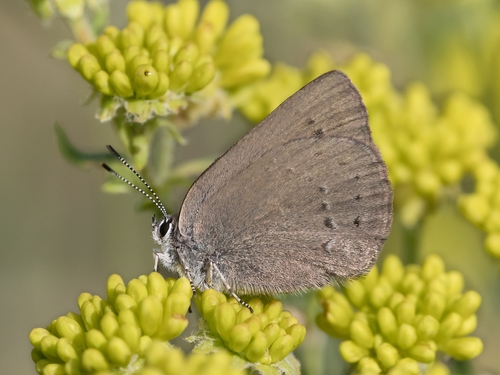
Callophrys rubi (Linnaeus, 1758), the green hairstreak, has a wingspan of 26–30 millimetres (1.0–1.2 in). The uppersides of the wings are uniformly dull brown; males have two paler patches of scent scales on their forewings. The wing undersides are bright green with a thin white line, which is often reduced to a faint row of dots or missing entirely. The iridescent green underside color is a structural color, produced by diffraction and interference of light from microscopic repeating structures that form a diffraction grating in the wing scales. Caterpillars are green with yellow markings along the back, and are rather sluglike, similar to other members of their family. The description from Seitz notes the species (listed as T. rubi L.) is black-brown above with white fringes; males have a scent patch on the forewing below the costa in the center. It is green below, with some white dots on the disc of the hindwing. In the aberration ab. immaculata Fuchs, these white dots are absent, while in ab. punctata Tutt they form a complete row that extends even to the forewing. Many named variations exist based on how complete or reduced the white row is (including caecus, incompleta, bipuncata), and these individual aberrations occur among specimens of the nymotypical race. The subspecies C. r. borealis Krulikovsky, 1890 (originally borealis Krul from Kasan) is slightly smaller, more yellowish green, and lacks the white dots of the nymotypical form. polaris Moschl, also classified as C. r. borealis Krulikovsky, 1890 from the northernmost parts of the species' distribution range, is a small form with duller green undersides. C. r. sibirica (Rühl, 1895) (originally sibirica Ruhl) differs from rubi rubi in nearly the same way, with less bright green undersides, and occurs in Northern Asia. C. r. fervida Staudinger, 1901 (originally fervida Stgr.) is a southern form with paler brown uppersides that carry a golden sheen. The taxon suaveola Stgr. is now recognized as the full species Callophrys suaveola (Staudinger, 1881) from Central Asia; it is as large as the largest European specimens of C. rubi, has a darker upperside and deeper green underside, and is found in Saisan and Lepsa. Since true C. rubi also occurs in these localities, suaveola may prove to be the summer brood of C. rubi. A number of additional individual varieties exist: for example, some specimens have brown instead of green undersides, and some females have a reddish yellow discal spot on the forewing upperside (recorded by Blachier). Eggs are depressed, green, and reticulate. Mature larvae are dark green, with a black-edged yellow dorsal line accompanied by pale spots, and a yellowish side-line. Larvae feed in June and autumn, particularly on Papilionaceae such as Sarothamnus, Genista, and Cytisus, but also feed on many other plants including oak, Vaccinium, and Sedum. They often bore deep into the flowers of Genista. Pupae are short, very rounded, and resemble a small bean; they are immobile, but nonetheless produce a faint noise described as creaking by Kleemann, and twittering or chirping by Schilde. Adult butterflies fly from April to July, and in warmer lowland districts there is a second brood in July and August, with the two broods almost overlapping, for example at Darmstadt. They are very abundant in most locations, always rest with closed wings on shrubs and green Genista twigs, are not wary, and spring specimens are especially fond of Potentilla flowers. The species' wide range of food plants allows it to occupy a broad variety of habitats, including chalk downland, heathland, moorland, and woodland clearings. It also occurs in wetlands and on poor dry meadows, at elevations from 0 to 2,300 metres (0–7,546 ft). Callophrys rubi is distributed across most of Europe, North Africa, Russia, Asia Minor, Siberia, Amurland, Baluchistan, and Chitral. It remains widespread across most of the UK, though many colonies have been lost in recent years. In Mediterranean countries it is quite localized and usually found near coasts. Adult butterflies can appear as early as the end of March, with flight season generally lasting to the end of June, though they are sometimes seen in July and early August. They never rest with their wings open, to maintain their green camouflage. Males exhibit territorial behavior. Eggs are laid singly. Unlike some related lycid larvae, C. rubi caterpillars are not known to be tended by ants. Pupae form at ground level, and emit squeaks that attract ants; it is thought that ants always bury any pupae they find. Green hairstreaks overwinter as pupae, and are univoltine, producing one generation of adult butterflies per year. Across its range, larvae have been recorded feeding on Vaccinium myrtillus, Vaccinum uliginosum, Betula, Rubus idaeus, Vicia cracca, Trifolium medium, Calluna vulgaris, Frangula, Rhamnus, Ribes, Spiraea, Caragana, Chamaecytisus, Hedysarum, Genista, Trifolium, and Hippophae rhamnoides. This polyphagous species likely has one of the largest food plant ranges of any British butterfly. Early butterfly collectors thought the only food plant was bramble (blackberry, Rubus fruticosus), but the list of known host plants grew as the species' habits were better studied, and will probably continue to expand. Depending on habitat, it uses common rock rose (Helianthemum nummularium), bird's-foot trefoil (Lotus corniculatus), gorse (Ulex europaeus), broom (Cytisus scoparius), Dyer's greenweed (Genista tinctoria), bilberry (Vaccinium myrtillus), dogwood (Cornus sanguinea), buckthorn (Rhamnus cathartica), cross-leaved heath (Erica tetralix), and bramble.