About Callistephus chinensis (L.) Nees
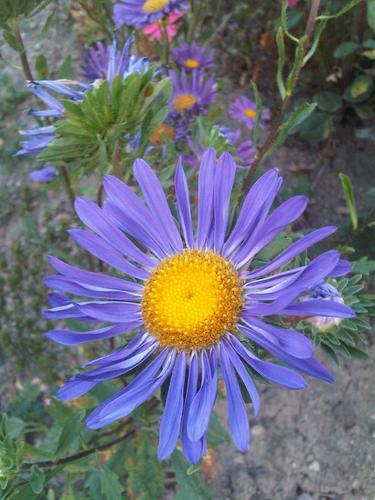
Callistephus chinensis (L.) Nees is an annual or biennial plant with a single mostly unbranched erect stem that reaches 20 to 100 cm (7.9 to 39.4 inches) tall. Its leaves are alternately arranged and variable in shape and size. Basal leaves usually drop off before the plant begins to flower. Mid-stem leaves are a few centimeters long, growing on winged petioles, with serrated edges on their leaf blades. Leaves near the top of the stem may have smooth edges. A large, solitary flower head forms at the top of the stem, and sometimes on branches. The flower head is surrounded by layers of phyllaries: outer phyllaries are large, leaf-like, and measure up to 3 centimeters long, while inner phyllaries may be purple-tinged. The flower head holds one or two rings of ray florets, which are most often in reddish purple shades. In the northern hemisphere, this species flowers from August to October. It is native to an unstated region and is naturalized outside its native range in areas including Indochina, Europe, North America, Australia, and New Zealand. It occurs naturally on the edges of deciduous forests, growing at altitudes between 300 and 2700 meters above mean sea level. As an ornamental plant, it grows best on fresh, nutrient-rich, humus-rich soils in warm, humid conditions. This species has been extensively grown and selectively bred in cultivation. Cultivars are available with flowers in a wide range of colors, varying plant heights, and both single and double flower heads. Wild plants of this species have purple flowers, and hybridization was specifically used to develop cultivars with flower colors outside of the wild purple shade. Cultivated varieties can produce ray florets in almost any color, including red, pink, blue, purple, and white; these ray florets can grow up to 3.5 centimeters long. The center of the flower head holds many yellow disc florets. Its fruit is a rough-textured, glandular, purple-mottled cypsela that turns gray as it ages. Its pappus has a single outer layer of reddish scales and two inner layers of white bristles. Callistephus chinensis has been cultivated in China for 2000 years, and in Europe since at least 1728.