About Callistemon salignus (Sm.) Colvill ex Sweet
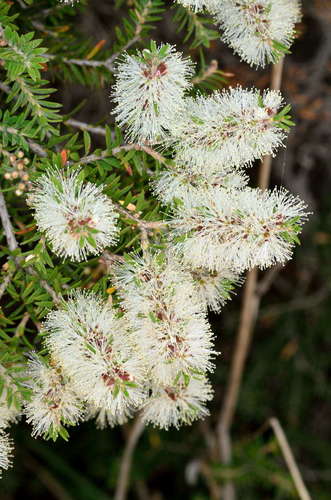
This species is currently classified as Melaleuca salicina, with the scientific synonym Callistemon salignus (Sm.) Colvill ex Sweet. It is a shrub or small tree that reaches up to 15 meters (50 feet) in height. It has soft, pink new growth and white or grey papery bark. Its leaves are arranged alternately along stems, measure 38–144 mm (1–6 in) long and 5–16 mm (0.2–0.6 in) wide, are more or less flat, narrow elliptic in shape, and taper toward both ends. Each leaf has a mid-vein, marginal veins, and 9 to 29 distinct lateral veins. The flowers are white or creamy-white, arranged in spikes at the end of or around branches; branches continue growing after flowering. Flower spikes are 20–35 mm (0.8–1 in) in diameter, 50–80 mm (2–3 in) long, and hold 10 to 40 individual flowers. Petals measure 2.6–4 mm (0.1–0.2 in) long and fall off as the flower ages, and each flower has 48 to 65 stamens. Flowering occurs from September to November, and is followed by woody capsule fruits that are 3.8–4.4 mm (0.1–0.2 in) long and 4–5 mm (0.16–0.20 in) in diameter. This melaleuca is distributed from the Victoria-New South Wales border along the New South Wales coast and ranges, extending north to the Biloela and Bundaberg districts of Queensland. It grows along watercourses, coastal waterways, and on river flats. It has been grown in gardens for many years, most frequently under its synonym Callistemon salignus, and under that name has received the Royal Horticultural Society's Award of Garden Merit. It can be planted to provide shelter and screening, and is well-suited for use as a street tree, or for planting in parks and gardens. Its flowers attract birds to gardens. This species grows well in a wide range of soil types, can tolerate both wet and dry conditions and near-coastal exposure, but it is not tolerant of frost. Pink and red colored forms of this species can be found in cultivation.