About Callistemon linearis (Schrad. & J.C.Wendl.) Colvill ex Sweet
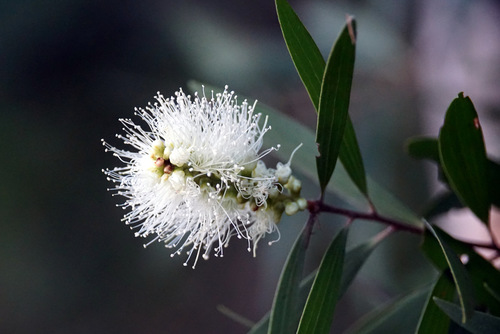
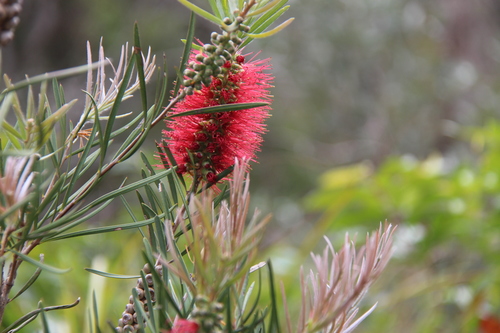
Melaleuca linearis (previously known by the scientific name Callistemon linearis (Schrad. & J.C.Wendl.) Colvill ex Sweet) is a shrub that grows up to 3 metres (10 feet) tall. It has grey, hard, fibrous bark. Its leaves are arranged alternately, measure 35–115 millimetres (1–5 inches) long and 0.7–2.7 millimetres (0.03–0.1 inches) wide, are narrow linear in shape, and range from flat to channelled or semi-circular in cross section. The leaves have a mid-vein, but their lateral veins are not easily visible. The flowers are most often red, rarely green, and arranged in spikes on branch ends (which continue to grow after flowering) and on the sides of branches. The flower spikes are 40–65 millimetres (2–3 inches) in diameter and 5–10 centimetres (2.0–3.9 inches) long, and hold 20 to 90 individual flowers. The petals are 3.2–7 millimetres (0.1–0.3 inches) long and fall off as the flower ages, and each flower has 23–73 stamens. Flowering takes place from late spring to early summer, and after flowering produces woody capsule fruits that are 3.8–8.2 millimetres (0.1–0.3 inches) long. This species occurs from the south-east corner of Queensland, through to Nowra on the south coast of New South Wales, and inland as far as Gilgandra. It grows in damp locations across a range of different vegetation types. This species has a long history of cultivation, where it has often been labelled as Callistemon linearis, C. pinifolius or C. rigidus. While it is not common in gardens, it is a hardy plant that grows well in most soils, although it prefers full sun. It is more resistant to pests such as sawfly than other melaleucas, and has been awarded the Royal Horticultural Society's Award of Garden Merit.