About Callistemon lanceolatus (Sm.) Sweet
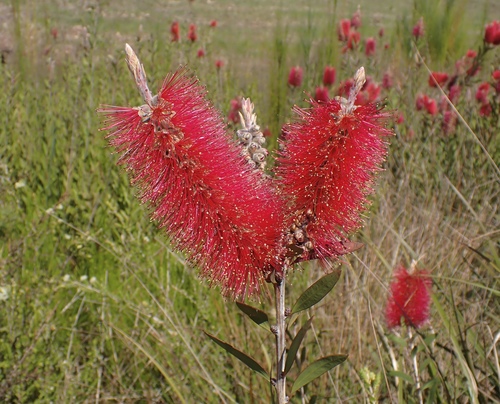
Melaleuca citrina (synonym Callistemon lanceolatus (Sm.) Sweet) is a shrub with a lifespan of approximately ten years. It grows to 5 meters (20 feet) tall, though it more commonly reaches 1–3 meters (3–10 feet) in both height and width. The shrub has hard, fibrous or papery bark, and its new young growth is usually covered with soft, silky hairs. Its leaves are arranged alternately along stems; they are 26–99 millimeters (1–4 inches) long and 4–25 millimeters (0.2–1 inch) wide, hard, flat, and narrow egg-shaped with the narrower end positioned closer to the stem base, ending in a pointed but not sharp tip. Between 7 and 26 branching veins are clearly visible on both sides of the leaves, and a large number of distinct oil glands are visible on both leaf surfaces. The flowers are red, arranged in spikes on the ends of branches that continue to grow after flowering, and sometimes also appear in upper leaf axils. The flower spikes measure 45–70 millimeters (2–3 inches) in diameter and 60–100 millimeters (2–4 inches) long, and hold up to 80 individual flowers. The petals are 3.9–5.8 millimeters (0.15–0.23 inches) long and fall off as the flower ages. Each flower contains 30 to 45 stamens, with red stalks (filaments) and purple tips (anthers). Flowering occurs through most months of the year, with peak flowering in November and December. After flowering, the plant produces woody, cup-shaped capsule fruits that are 4.4–7 millimeters (0.2–0.3 inches) long and about 7 millimeters (0.3 inches) wide. These capsules form cylindrical clusters along the stem, and remain unopened until the entire plant, or the branch section bearing the capsules, dies. Melaleuca citrina occurs in near-coastal areas of New South Wales, Australia, including the Blue Mountains, and extends west as far as the Central Western Slopes. It also grows in east coast areas of Victoria, where it inhabits swamps and the banks of creeks and rivers. Birds have been observed feeding on this species: eastern spinebills, New Holland honeyeaters, noisy miners, red wattlebirds, and silvereyes seek nectar from its flowers, while crimson rosellas eat its seeds.