About Callistege mi (Clerck, 1759)
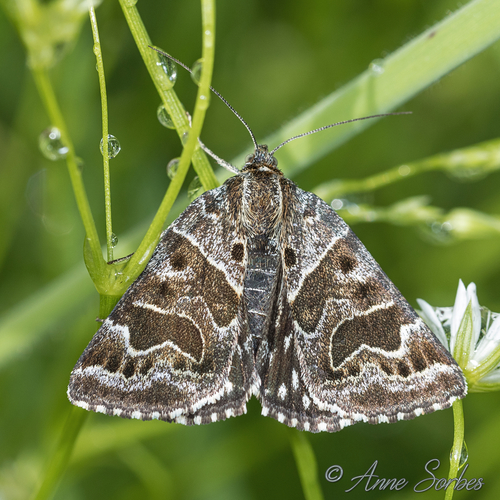
Technical description: The forewing of an adult Callistege mi moth measures 13 to 16 mm (0.51 to 0.63 inches) in length, and the total wingspan ranges from 25 to 30 mm (0.98 to 1.18 inches). Forewings are primarily black, lightly dusted with grey scales. The wing lines are whitish; the subbasal line ends in a black spot with a grey edge on the inner margin. The inner line is obliquely curved outwards. The outer line is angled at vein 6, indented at vein 4, angled inwards below vein 2, runs upwards and outwards below the reniform stigma, then moves downwards again parallel to its previous path, and finally joins the inner line above the inner margin. The orbicular stigma is a round black spot with a grey outline. The reniform stigma is large and black, edged externally by a white bar; this white bar often has a narrow pale line extending outwards from its middle. The subterminal line is sinuous, double, and somewhat lunulate, with a dark center and pale-scaled edges; it is single and white at the costa, and preceded by oblong black spots separated by pale veins. Hindwings have an ochreous white cell that contains a black cellspot. Outside the cell, there are outer and subterminal sinuous series of ochreous white spots positioned between the veins. The fringe of both wings is mottled black and white, with a pale line at its base; the underside of the wings is ochreous white. The larva is yellowish, with a dark dorsal line that has a fine pale center, and several fine wavy lines on each side of the dorsal line. The spiracular line is broad, dark reddish brown, and edged below with yellow or red. Distribution: This species occurs across most of Europe, Siberia, the Russian Far East, and Asia Minor. In the British Isles, it is most common in England and Wales, and less common in Scotland and Ireland.