About Callisia repens (Jacq.) L.
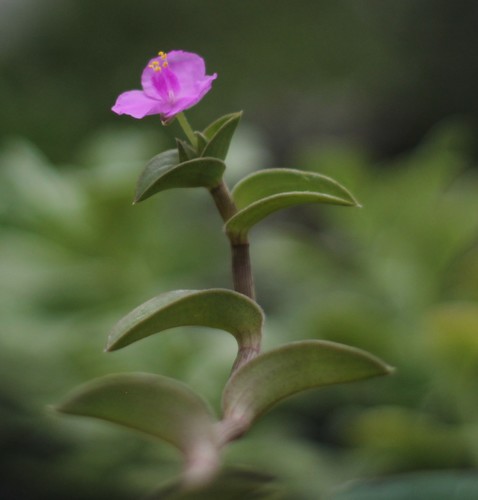
Callisia repens (Jacq.) L. is a perennial plant that forms creeping mats, with ascending flowering shoots. It has fleshy, delicate leaves that grow smaller toward the tip of the shoot. Leaf blades are oval to lanceolate, 1 to 3.5 centimeters long and 0.6 to 1 centimeter wide. For distal leaves, the blades are narrower than the open, spread leaf sheaths. This species grows quickly and multiplies easily via long creeping shoots; each node develops roots as soon as the shoot touches the ground.
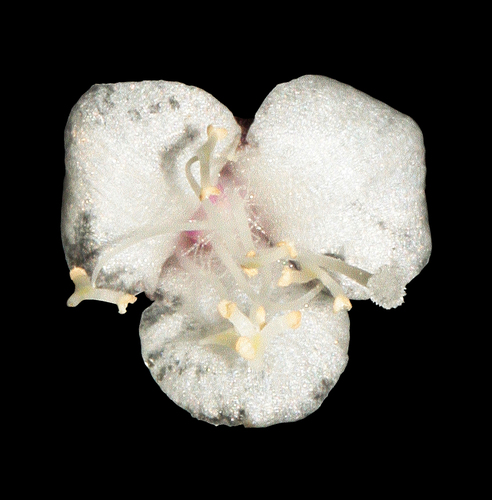
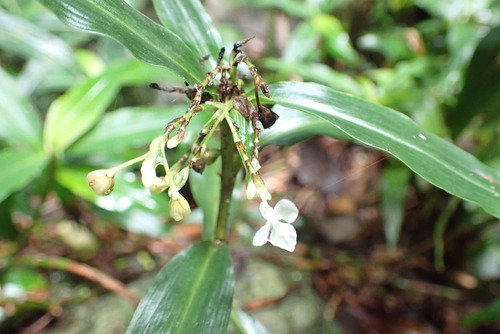
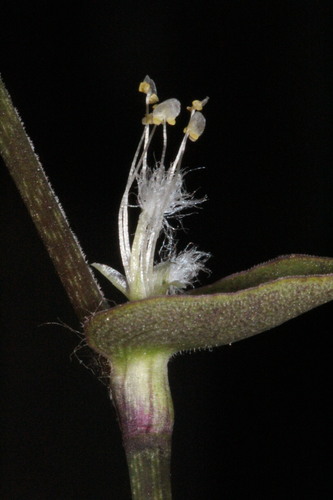
Inflorescences are located in the axils of the distal leaves of flowering shoots, and consist of paired cymes. The flowers, produced in summer, are hermaphroditic and odorless. The bracts are inconspicuous, white, lanceolate, and three to six millimeters long. There are zero to six stamens with smooth filaments. The ovary is bipartite and has a brush-like stigma. After flowering, it develops capsule fruits that contain one-millimeter large seeds.
The species is native to the Americas, ranging from the southeastern United States (Texas, Florida) through the West Indies (Guadeloupe and Martinique) to Argentina. It grows in shady, rocky or gravelly areas within subtropical to tropical forests. It is naturalized in Hong Kong, where it grows on rooftops. In Western Australia, it is an invasive species: its rapid growth, tolerance to varied environments, and ground cover habit allow it to spread very quickly, suffocating native plants or preventing them from germinating.
Callisia repens is sometimes grown as an ornamental plant, and is easily propagated by cuttings. It is also sold as a houseplant, valued for its drooping growth habit and the scent of its white flowers. Exposure to strong light causes the foliage to turn pinkish-red, and the plant can tolerate direct sunlight if humidity levels are high. The optimal conditions for growth are daytime temperatures between 18–22 °C, and nighttime temperatures of at least 12 °C. Common pests that affect this plant include snails.