About Callaeas cinereus wilsoni (Bonaparte, 1850)
General Appearance
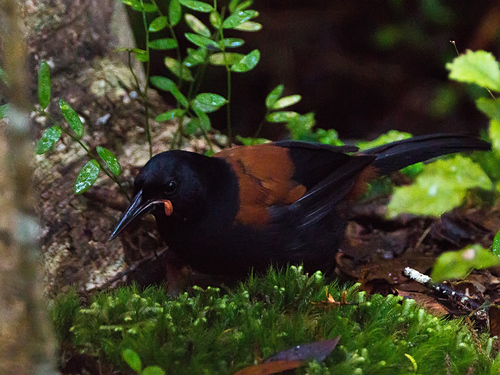
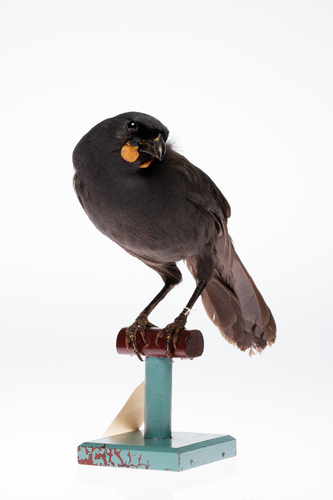
This subspecies, the South Island kōkako, matches the general appearance of the North Island kōkako: it is a slate-grey bird with long legs and a small black mask.
Naturalist Reischek noted that its plumage is slightly lighter than that of the North Island kōkako.
Wattle Characteristics
Its wattles are a distinct bright orange with a dark blue base, while juvenile South Island kōkako have much lighter wattles.
Locomotion Behavior
This subspecies appears to have spent more time on the ground than the North Island kōkako, and was also a stronger flier.
Average Weight
The average weight of an individual is 230 grams.
Kōkako Call Traits
All kōkako produce characteristic duetting calls that resemble organ music and flute tones.
Early explorer Charlie Douglas described the South Island kōkako's call as having very few notes, but being the sweetest and most mellow bird call he had ever heard.
Egg Characteristics
Records of South Island kōkako eggs confirm they were larger than the eggs of North Island kōkako.
Historic Distribution at European Settlement
At the time of European settlement, South Island kōkako inhabited the South Island West Coast, ranging from northwest Nelson to Fiordland, and were also present on Stewart Island, Banks Peninsula, and the Catlins.
Pre-European Distribution
Subfossil bone evidence shows this subspecies was once found across the entire South Island, but Māori forest burning removed it from dry eastern lowland forests.
Population Decline Timeline
Introduced mammalian predators and forest clearing by European settlers further reduced their populations: by 1900 the subspecies was already uncommon across the South Island and Stewart Island, and it had nearly disappeared by 1960.
Decline Vulnerability Cause
Its greater vulnerability to decline compared to the North Island kōkako may stem from its habit of foraging and nesting close to the ground.