About Caleta roxus
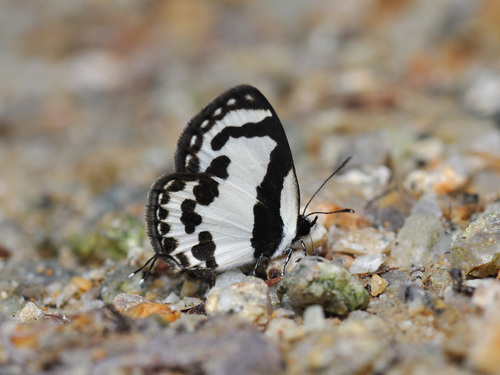
Caleta roxus is a butterfly species with distinct morphological features separating males and females. For males, the upperside of the wings is black, with an oblique medial white band that spans both the forewings and hindwings. This band starts above vein 5 on the forewing and extends from the dorsum of the hindwing. On the forewing, the band extends outward slightly above vein 3, and the apex of this extension is square. The underside of the wings is white, lightly suffused with pale yellow, and marked with the following black patterns: a comparatively broad, even, straight band crosses the base of the hindwing; this band continues obliquely across the forewing to the middle of the costa, where it is joined by a narrow costal margin edging that connects to an irregular, upper, discal, outwardly oblique, short transverse bar, which is widest at the costa. Posteriorly aligned with this bar is a small, transversely elongate oval spot in interspace 3. Below this spot, arranged en echelon with it, are two larger coalescent spots stacked one above the other in interspaces 1 and 2. The terminal margin has an even transverse band, with a slightly scalloped (crenulate) inner edge, and a series of minute linear white spots runs through the middle of this band. On the male hindwing, there is a transverse, discal, very irregular band that is widely interrupted in the middle. Beyond this band, two coalescent spots lie transversely across interspaces 4 and 5. These are followed by a complete, curved subterminal series of distinct lunules, each thinly edged with white on the outer side, plus a prominent anteciliary white line. The cilia of both forewings and hindwings are brown. The short filamentous tail on the hindwing is black with a white tip. The antennae, head, thorax, and abdomen are black; the abdomen has white bars along its sides. On the underside, the palpi, thorax, and abdomen are white along the midline. Females closely resemble males, but the broad oblique medial white band crossing the wings on the upperside is distinctly broader. On the forewing, this band extends farther toward the costa in a point. In addition, many female specimens have a complete transverse subterminal series of linear white dots on the hindwing. On the underside, all black markings are broader than in males. On the female forewing, the short oblique black upper discal bar extends to and coalesces with the black spot in interspace 3. On the female hindwing, the transverse discal black band is very irregular but nearly continuous, as its upper portion connects to the spots in interspaces 4 and 5. The terminal markings on both wings match those of the male. Female antennae, head, thorax, and abdomen match those of the male. This butterfly is distributed from Assam in India to Myanmar, and ranges across Yunnan, Thailand, Cambodia, and Indochina. It is also found throughout Peninsular Malaysia, the Indonesian and Philippine archipelagos, and extends all the way to New Guinea.