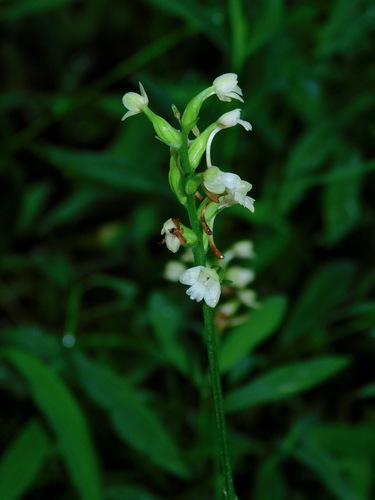
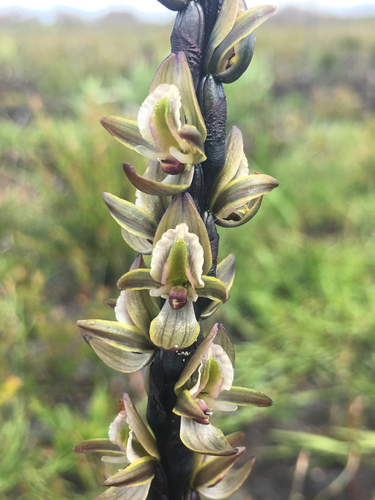
About Caleana minor R.Br.
Caleana minor (commonly known as the small duck orchid) is a tuberous perennial herb. It produces a single linear, reddish brown leaf that measures 40–130 mm (2–5 in) long and 1–3 mm (0.04–0.1 in) wide, and is folded along its length. This leaf usually withers by the time the plant begins flowering. Between one and four yellowish green to reddish brown flowers grow on a flowering stem 80–150 mm (3–6 in) tall; each flower is 14–16 mm (0.55–0.63 in) long and 5–7 mm (0.2–0.3 in) wide. The plant's sepals and petals are 7–10 mm (0.3–0.4 in) long and 1–2 mm (0.04–0.08 in) wide, and hang downwards to form a bucket-like shape with the broad wings of the flower's column. The labellum is 5–6 mm (0.20–0.24 in) long and 3–4 mm (0.1–0.2 in) wide, covered with glossy black glands, and held above the flower on a sensitive strap-like stalk about 5 mm (0.2 in) long. Flowering occurs from September to February, with a shorter flowering period in New Zealand. This species occurs in eastern Australia and the North Island of New Zealand. It is widespread and locally common across Australia, where it grows in a wide range of habitats, most commonly on ridges and slopes in forests. In Queensland, it is found south from Carnarvon National Park. It grows in the eastern half of New South Wales as far west as Dubbo, throughout all of Victoria except the far north-west, in south-eastern South Australia, and across Tasmania. In New Zealand, the species is currently only known to grow at Whakarewarewa near Rotorua, and is classified as critically threatened. There are only two other historical records of the species in New Zealand, one from Kaitaia and one from Waiotapu. It is uncertain whether Caleana minor is indigenous to New Zealand; some experts consider it an introduced species. It has been hypothesized that the species arrived to New Zealand as seeds carried in mud on an Australian visitor's shoe, or that seeds were blown from Australia by bushfire smoke. This orchid is pollinated by insects. The sensitive strap-like stalk holds the labellum above the flower; when the labellum is touched, it swings rapidly downward, trapping the visiting insect between the labellum and the column wings.