About Calanthe triplicata (Willemet) Ames
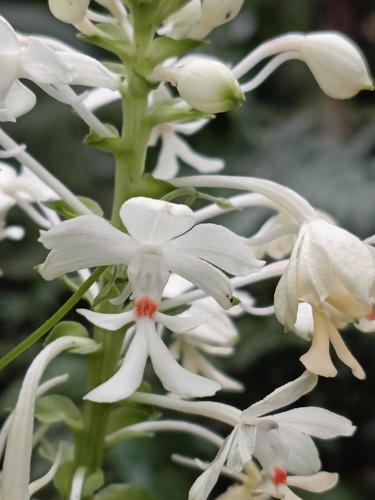
Calanthe triplicata is a terrestrial, evergreen herb that grows in clumps. It produces crowded, fleshy, oval pseudobulbs that measure 40–80 mm (2–3 in) long and 20–40 mm (0.8–2 in) wide. Each pseudobulb bears 4 to 9 dark green, lance-shaped, corrugated leaves, which are 250–900 mm (10–40 in) long and 60–180 mm (2–7 in) wide, tapering toward the base. The leaf veins are roughly parallel, with between 6 and 9 veins that are more prominent than the others. Between 18 and 40 white flowers, each 25–35 mm (0.98–1.4 in) wide, grow crowded near the top of an upright flowering stem 50–1,500 mm (2–60 in) long. The sepals are egg-shaped, 6–19 mm (0.2–0.7 in) long and 6–7 mm (0.2–0.3 in) wide. The petals are similar in shape to the sepals, 5–15 mm (0.2–0.6 in) long and 2–6 mm (0.08–0.2 in) wide. The labellum has three widely spreading lobes 4–15 mm (0.2–0.6 in) long and 2–6 mm (0.08–0.2 in) wide, with the middle lobe further divided into two sections. A curved spur grows behind the labellum, measuring 10–30 mm (0.4–1 in) long. Flowering occurs from October to February in Australia, and in April and May in China.
Calanthe triplicata is distributed across Mauritius, Madagascar, Seychelles, Assam, eastern Himalayas, southern India, Sri Lanka, Myanmar, Thailand, Malaysia, Laos, Cambodia, south China, Vietnam, Borneo, Java, Lesser Sunda Islands, Moluccas, Philippines, Sulawesi, Sumatra, Bismark Islands, New Guinea, Solomon Islands, Australia, Fiji, New Caledonia, Samoa, Vanuatu, Wallis and Futuna, Marquesas, Santa Cruz Islands, Caroline Islands, the Marianas Islands, Taiwan, and the Ryukyu Islands. In Australia, it occurs between the Iron Range in Queensland and the Illawarra in New South Wales, as well as on Norfolk Island and Lord Howe Island. It grows in dense shade within evergreen broad-leaved forests, rainforests, and other wet forests.