About Calanthe tankervilleae (Banks) M.W.Chase, Christenh. & Schuit.
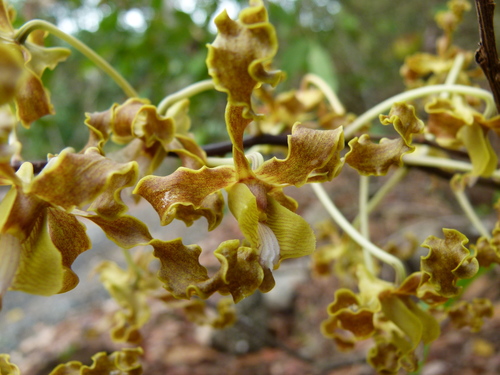
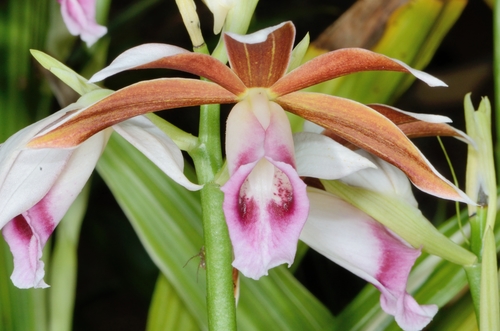
Calanthe tankervilleae (Banks) M.W.Chase, Christenh. & Schuit. is an evergreen, terrestrial herb that produces cone-shaped or roughly spherical pseudobulbs. These pseudobulbs usually measure 60–80 mm (2–3 in) long and 30–60 mm (1–2 in) wide. Two to eight pleated linear to lance-shaped leaves, 300–1,000 mm (10–40 in) long and 80–200 mm (3–8 in) wide, grow from each pseudobulb. Ten to 25 resupinate flowers, each 70–125 mm (3–5 in) wide, are borne on a flowering stem that reaches 500–2,000 mm (20–80 in) tall. The flowers are whitish on the outside and reddish brown on the inside. The sepals and petals are oblong to lance-shaped, measuring 40–65 mm (2–3 in) long and 10–15 mm (0.4–0.6 in) wide. The labellum is pink or reddish with a white tip and white stripes on the inside, 35–60 mm (1–2 in) long and 20–50 mm (0.8–2 in) wide, and divided into three lobes. The middle lobe is roughly tube-shaped, and the side lobes have wavy or crinkled edges. A whitish yellow spur 5–10 mm (0.2–0.4 in) long grows near the base of the labellum, and a narrow raised callus is located at the labellum's center. Flowering occurs from September to November for Australian populations, and from March to June for Asian populations. Calanthe tankervilleae grows in swampy forest or grassland. It is native to the Indian subcontinent, New Guinea, China, Japan, Southeast Asia, Indonesia, Malaysia, the Philippines, Australia, and certain Pacific islands. It is also naturalized in Hawaii, Panama, the West Indies, and Florida. In Australia, the taxon recognized as P. tankervilleae var. australis is found as far south as Yamba, New South Wales, and extends north into tropical Queensland. This species is rare in parts of its native range, but persists as a naturalized species in other regions of the world, including Hawaii and Florida.