About Calamus muelleri H.Wendl.
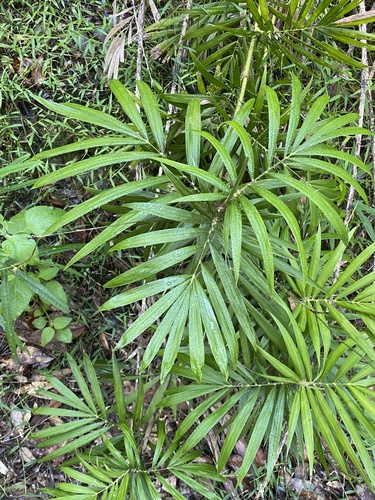
Calamus muelleri H.Wendl. is a clustering, climbing palm that grows up to 20 m (66 ft) in length, with thin stems reaching a maximum diameter of 16 mm (0.63 in). Its pinnate fronds are arranged alternately and are more or less sessile, growing up to 1 m (3 ft 3 in) long with 7 to 13 leaflets on each side of the frond. Long recurved spines grow on the frond rachis; leaflets have spines along their upper surface midrib, and small sharp spurs on their margins. The leaf sheath is densely covered in spines. Like other species in the Calamus genus, this plant produces a modified sterile inflorescence called a flagellum, which grows up to 1.2 m (3 ft 11 in) long. The flagellum is armed with dozens of strong, recurved barbs that act as grappling hooks to latch onto nearby vegetation and provide support for the plant. Fertile inflorescences grow up to 1 m (3 ft 3 in) long, and this species flowers in every month of the year. Its fruits are globose drupes around 12–16 mm (0.47–0.63 in) in diameter, each containing a single seed. Calamus muelleri grows in rainforests and wet sclerophyll forests in subtropical eastern Australia, with a range extending from around Gympie in Queensland south to the Bellinger and Hastings Rivers in New South Wales. Laetesia raveni, a spider species endemic to eastern Australia, builds its webs exclusively on two spiny plant species: Calamus muelleri and Solanum inaequilaterum. Aboriginal Australians used the cane stems of Calamus muelleri for weaving.