About Calamus moti F.M.Bailey
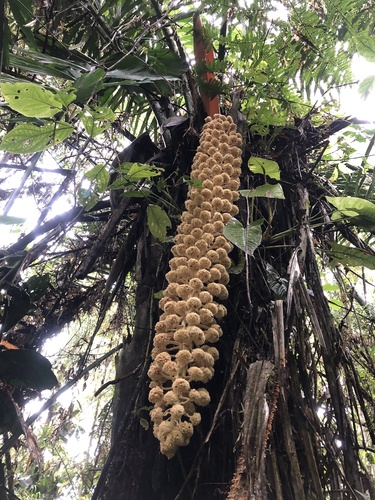
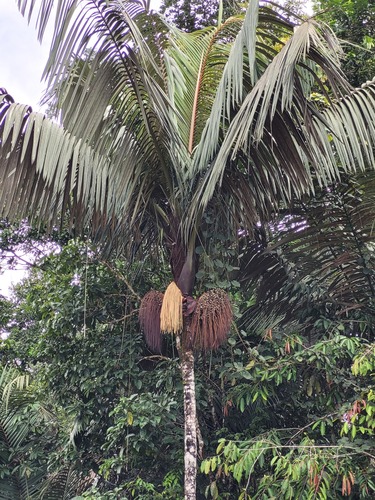
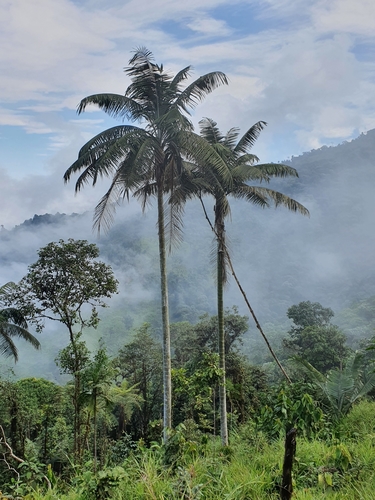
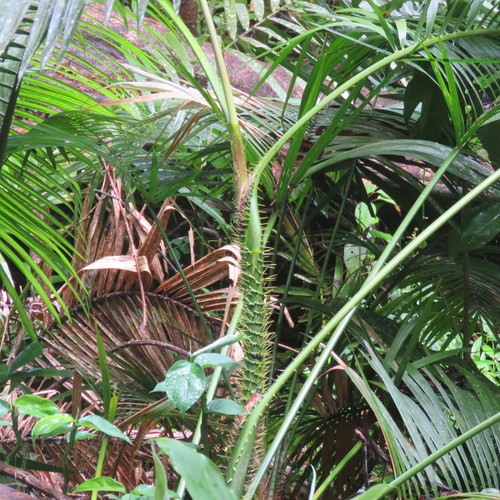
Calamus moti F.M.Bailey is a clustering, climbing palm. It is the largest of the eight Calamus species native to Australia, with stems reaching up to 5 cm (2.0 in) in diameter and 45 m (148 ft) in length. Its leaves grow up to 3 m (10 ft) long, and are pinnate with 35 to 50 leaflets positioned on either side of the rachis. Three longitudinal rows of stout recurved hooks grow on the underside of the rachis. The leaflets are linear-lanceolate, measuring up to 60 cm (24 in) long by 3 cm (1.2 in) wide, with very fine barbs along their margins. On the upper surface of each leaflet, there are two longitudinal rows of spines (one on either side of the central vein), with spines reaching up to 10 mm (0.39 in) long. Leaf sheaths completely surround the stem, and are covered with stout yellow-green spines around 20 mm (0.79 in) long arranged in oblique combs. Flagella covered with stout recurved barbs grow from the leaf sheath, acting as grappling hooks to support the flexible stem. On older sections of the stem, fronds and their leaf sheaths fall off, exposing the stem's smooth, glossy green surface. Calamus moti is endemic to Queensland, Australia, with a range from near Cooktown southwards to around Mackay. It grows in well-developed rainforest, reaches its peak growth close to water courses, and can be found at elevations from near sea level up to about 1,300 m (4,300 ft). This species, commonly called yellow lawyer cane, is a host plant for the white-fringed swift, Sabera fuliginosa, a butterfly in the family Hesperiidae, and its fruits are eaten by birds. Indigenous communities of north Queensland ate the species' fruits and young shoots, while the cane from its stem was used for many purposes including axe handles, fish and animal traps, shelters, and baskets.