About Calamus australis Mart.
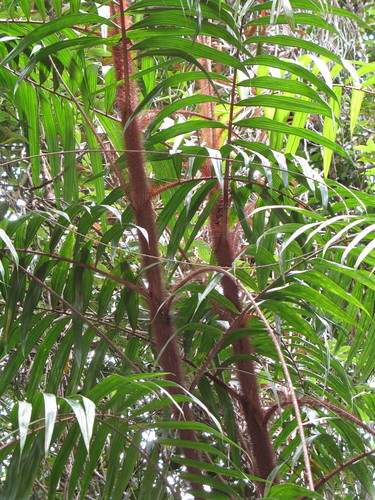
Calamus australis Mart. Stems of this species can grow up to 35 m (110 ft) long and 2 cm (0.8 in) in diameter. Leaves (fronds) only grow on the youngest portion of the stem; as leaves age and fall off, older stem sections become bare, a growth process identical to that of the more familiar upright palm with a thick stem. The older, leafless part of the stem of Calamus australis is smooth and glossy green. The leaves have a long leaf sheath that clasps the stem, and this sheath is densely covered in needle-like spines up to 10 cm (3.9 in) long, though most spines are shorter. Several-metre-long tendrils armed with many stout, recurved barbs grow from the leaf sheath. The leaf itself is pinnate, growing up to 1.5 m (5 ft) in length, with around 20 to 25 pairs of leaflets. The lower surfaces of the leaf rachis are armed with stout recurved barbs. Unlike its very close relative C. radicalis, Calamus australis does not have spines on its leaflets. The overall outline of the leaf is elliptic, with the longest leaflets located at the midpoint of the frond; these largest leaflets measure about 30 cm (12 in) long by 3 cm (1.2 in) wide. Inflorescences are pendulous panicles up to 2 m (6.6 ft) long, and each panicle carries either staminate (functionally male) or pistillate (functionally female) flowers. The fruit is a white or cream drupe around 8 to 14 mm (0.3 to 0.6 in) in diameter, with a scaly outer surface. It contains a single spherical seed surrounded by a thin layer of soft edible flesh. This is the most widespread of the eight Calamus species native to Australia. It is endemic to tropical regions of Queensland, occurring from the tip of Cape York Peninsula south to near Rockhampton on the Tropic of Capricorn, and ranges from sea level up to around 1,600 m (5,250 ft) in elevation. It grows in gallery forest and mature rainforest. Fruits of this species are eaten by fruit doves of the genus Ptilinopus and southern cassowaries (Casuarius casuarius). Indigenous Australians used this plant and its sister species in many ways: young shoots and fruits were eaten. The long flexible stem was used to construct shelters, make axe handles, fish traps, snares, and waist straps for climbing trees, and the thorny tendrils were used to catch fish.