About Calamia tridens Hufnagel, 1766
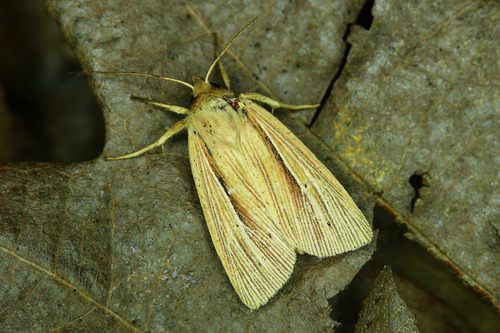
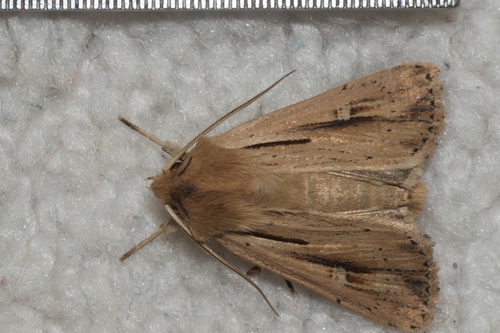
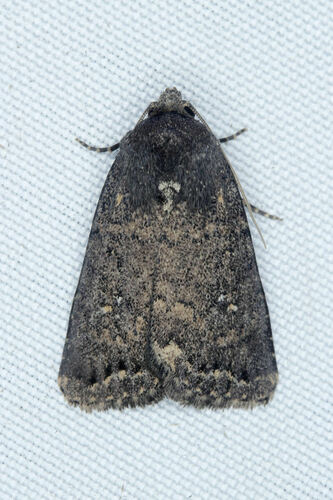
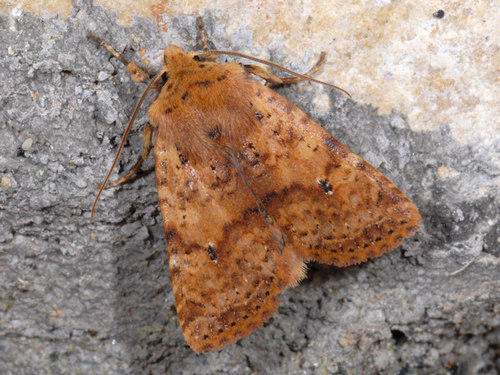
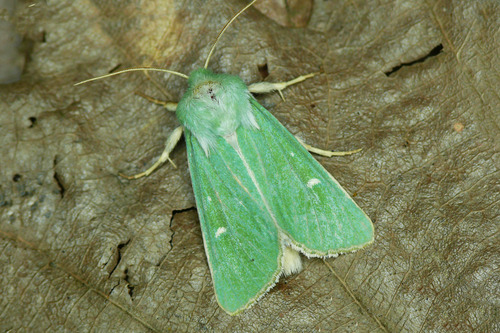
Calamia tridens Hufnagel, 1766 has a wingspan of 37–42 mm, with forewings 17–18 mm long. The typical form is whitish green; forewings are more or less grey-suffused except along the costa, with a pale curved outer band and white fringe. The aberration ab. immaculata Stgr. has uniformly green forewings with no trace of a white reniform, and male hindwings that are not fuscous. The new aberration ab. thalassina ab. nov. [Warren] has glossy dark sea-green forewings, with the outer half of the fringe greenish; hindwings are green flushed with darker green, with green veins; head and thorax are sea-green matching the forewings, while the abdomen is white as in typical virens. This aberration is described from 1 male and 2 females held in the Tring Museum, which unfortunately lack a locality label but are probably of German origin. One female has a diffuse whitish smear on the discocellular, and the other two specimens are immaculate. The new aberration ab. rufata ab. nov. [Warren] has a reniform filled with rufous fuscous, or a white discocellular edged with rufous, and the entire hindwing is brownish grey with white fringe. Calamia tridens is found in the Palearctic realm. Its recorded distribution includes Central Europe: it is not present in Britain, but occurs in Ireland, is found in southern Sweden, and is absent from southeast France, Spain, and southern Italy. It also occurs in West and Central Russia, Hungary, South Russia, Armenia, Asia Minor, Iran, West Siberia extending to the Altai Mountains, Kazakhstan, Issyk-kul, and the Tarbagatai Mountains.