About Calamagrostis arenaria (L.) Roth
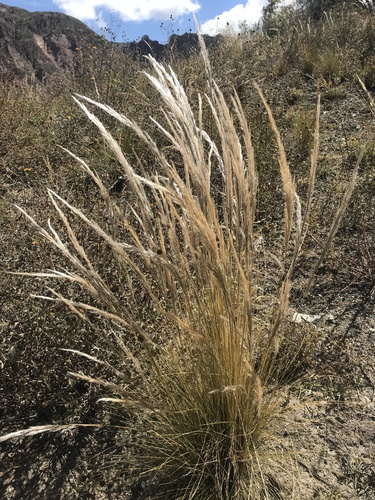
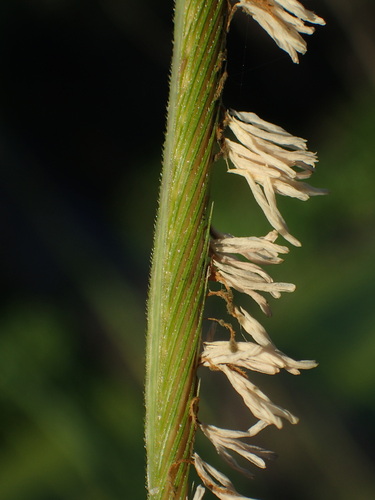
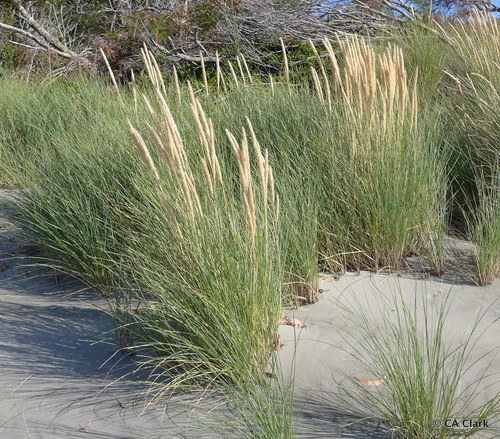
Calamagrostis arenaria (L.) Roth, also known by the synonym Ammophila arenaria, is a grass species in the family Poaceae. Its common names are marram grass and European beachgrass, and it is one of two species classified in the genus Ammophila. This grass is native to the coastlines of Europe and North Africa, where it grows in the sand of beach dunes. It is a perennial grass that forms stiff, hardy clumps of erect stems that reach up to 1.2 metres (3.9 ft) in height. It grows from a network of thick rhizomes that anchor it firmly in its sandy substrate, and allow the plant to spread upward as sand accumulates. These rhizomes can grow 2 metres (6 ft 7 in) laterally over six months, and a single clump can produce 100 new shoots each year. Rhizomes tolerate submersion in sea water; they can break off, float along on currents, and establish new populations of the grass at new sites. Its leaves can grow up to 1 metre (3 ft 3 in) long and are sharply pointed. Its cylindrical inflorescence grows up to 30 centimetres (12 in) long. This species is adapted to habitats with shifting, accreting sand layers, as well as habitats composed of stabilized dunes. This species is native to Europe and North Africa, and also occurs in Australia, Canada, Chile, the sub-Antarctic Falkland Islands (Malvinas), New Zealand, South Africa, and the United States. In the Northern Hemisphere, it grows between 30 and 63 degrees north latitude. In New Zealand, it usually occurs on sand dunes, and sometimes grows in low-fertility inland sites. It is found across the North and South Islands, and the Chatham Islands. Marram grass grows on coastal sand dunes around the world. It prefers growing on active sand areas and the windward side of the foredune. It prefers well-drained soils with various mineral compositions and low organic matter content. Optimal growth conditions for marram grass are a soil pH between 4.5 and 9.0, soil temperatures between 10–40 °C (50–104 °F), and salt concentrations no higher than 1.0–1.5%. Marram grass can also grow on alkaline soils with a pH as high as around 9.1, and on acidic soils with a pH lower than 4.5. Mature plants can tolerate a wide range of unfavorable chemical conditions, and adapts very well to dry sand. When moisture levels are low, its leaves roll into a tight shape to conserve water. As a perennial plant, marram grass can live for many years. It grows mainly in spring, when leaf production outpaces leaf senescence. Autumn conditions cause the plant to nearly stop growth, while its leaves age. Cold winter temperatures lead to very slow growth that does not stop entirely. As a xerophytic drought adaptation, its leaves curl during dry conditions. The higher humidity inside the curled leaf slows water loss. This curling and uncurling is controlled by bulliform cells located at the base of the leaf’s V-shaped notch: when filled with water, the cells swell and uncurl the leaf. This plant is highly adapted to sandy environments, and can withstand being buried by sand for over a year. Unlike most other plants that die when buried in sand, marram grass elongates its leaves when buried by sand. Inflorescences begin developing in the autumn of the second year after germination, mature in May or June, and the plant produces flowers from May to August. Fruit matures by September, and seeds germinate the following spring. Although mature marram grass plants are robust, its seeds have low viability, and seedlings also have low survival rates due to desiccation, burial, and erosion. Rhizomes are the plant’s main reproductive organ; they are dispersed along shorelines by wind and water. The roots of marram grass are edible, though they are thin and fibrous. Its flowering stems and leaves are used for thatching, basketry, and making brooms. Stem fiber is used to make paper, and rhizomes are used to make rope and mats.