About Caladenia venusta G.W.Carr
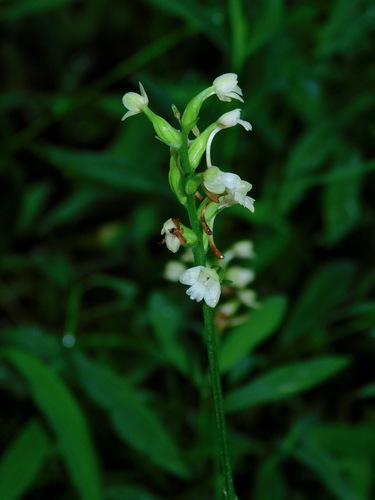
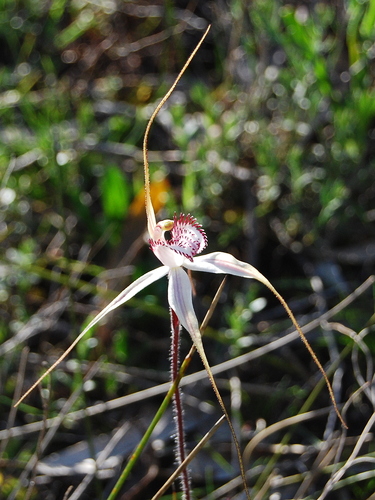
Caladenia venusta is a terrestrial, perennial, deciduous herb that grows from an underground tuber. It produces a single leaf that measures 100–180 mm long and 8–12 mm wide. One or two white to cream-coloured flowers, each 80–120 mm wide, are borne on a flowering spike 200–600 mm high. The sepals and petals have thick, brown, thread-like tips. The erect dorsal sepal is 60–100 mm long and 2–4 mm wide. The lateral sepals are 60–100 mm long and 4–8 mm wide; they spread apart from each other and have drooping tips. The petals are 50–80 mm long and 3–6 mm wide, and also have drooping tips. The labellum is white or cream-coloured, with its tip rolled under and sides turned upwards. Many thin, reddish teeth up to 3.5 mm long grow along the sides of the labellum, and four or six rows of narrow, reddish foot-shaped calli up to 2 mm long run along its mid-line, with the longest calli located near the base of the labellum. Flowering takes place from September to November. This species, commonly called the graceful spider orchid, is most common in Victoria, although it is considered rare even within that state. It usually grows in coastal woodland, but also occurs in the Grampians. It has been recorded in the far south-east of South Australia, and may also be found on the south-west slopes of New South Wales.