About Caladenia tessellata Fitzg.
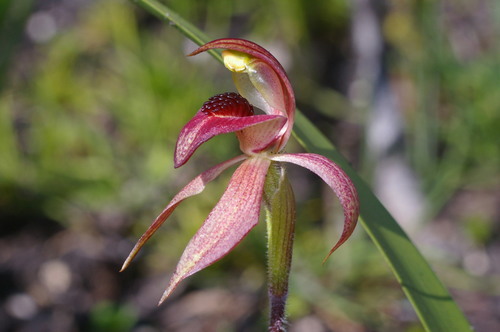
Caladenia tessellata Fitzg. is a terrestrial, perennial, deciduous herb that grows from an underground tuber. It produces a single, sparsely hairy leaf that is linear to lance-shaped, between 50 and 100 millimetres long and 4 to 9 millimetres wide. Up to three yellowish-green flowers with dark red markings grow on a thin, wiry stalk that is 20 to 150 millimetres tall. The sepals and petals taper to fine, short, thread-like tips. The dorsal sepal measures 15 to 25 millimetres long and 2 to 3 millimetres wide; it stands erect at its base, then curves forward. The lateral sepals are 15 to 25 millimetres long and 3 to 5 millimetres wide; they curve downwards and are nearly parallel to each other. The petals are 15 to 25 millimetres long, around 2 millimetres wide, and also curve downwards. The labellum is cream-coloured to green, often with a dark red tip. It is heart-shaped, and measures 8 to 9 millimetres in both length and width. The sides of the labellum often have a few short, blunt teeth, its tip curls under, and there are four to six rows of shiny black calli in the lower central area. Flowering occurs in September and October. This species of caladenia is found in near-coastal areas from Swansea in New South Wales to Westernport Bay in Victoria, and there is an additional inland population near Braidwood. It most commonly grows in grassy woodland.