About Caladenia speciosa Hopper & A.P.Br.
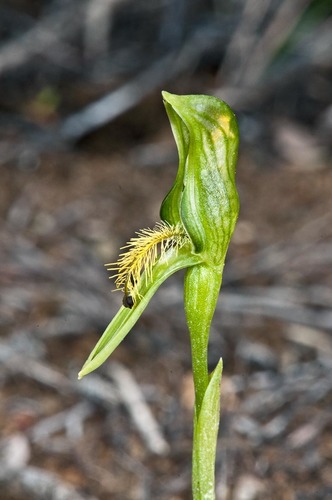
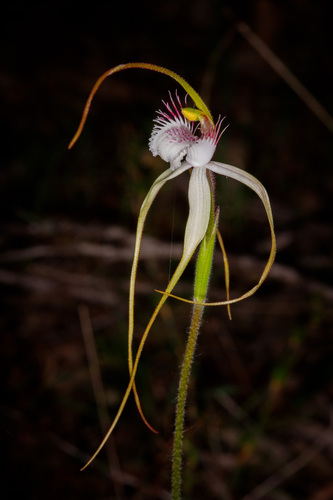
Caladenia speciosa, also known as the sandplain white spider orchid, is a terrestrial, perennial, deciduous herb. It grows from an underground tuber and produces a single erect, hairy leaf that is 150–250 mm (6–10 in) long and 5–12 mm (0.2–0.5 in) wide. Up to three flowers, each 120–180 mm (5–7 in) long and 100–150 mm (4–6 in) wide, are borne on a stalk 350–600 mm (10–20 in) tall. The flowers are white, often with a pink or red tinge, and the sepals and petals have long, thin, brownish thread-like tips. The dorsal sepal is erect, 80–130 mm (3–5 in) long and 2–4 mm (0.08–0.2 in) wide. The lateral sepals are 80–150 mm (3–6 in) long and 5–9 mm (0.2–0.4 in) wide; they spread widely and horizontally near their base, then curve downwards. The petals are 65–105 mm (3–4 in) long and 3–6 mm (0.1–0.2 in) wide, and are arranged the same way as the lateral sepals. The labellum is 20–30 mm (0.8–1 in) long and 8–16 mm (0.3–0.6 in) wide, and is white with erect, narrow red teeth up to 15 mm (0.6 in) long along its sides. The tip of the labellum is curled under, and there are between four and six rows of pink or white calli along the labellum's mid-line. Flowering occurs from September to October, and is more prolific after fire in the previous summer. This orchid is found between Mundijong and Boyanup in the Jarrah Forest and Swan Coastal Plain biogeographic regions of southwestern Australia, where it grows in woodland.