About Caladenia saccharata Rchb.f.
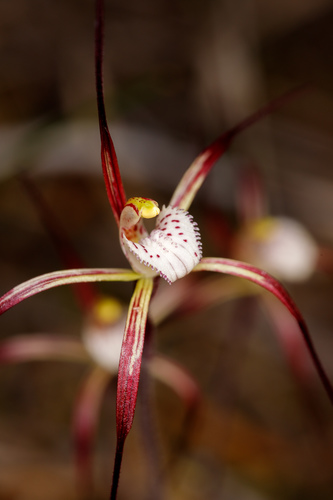
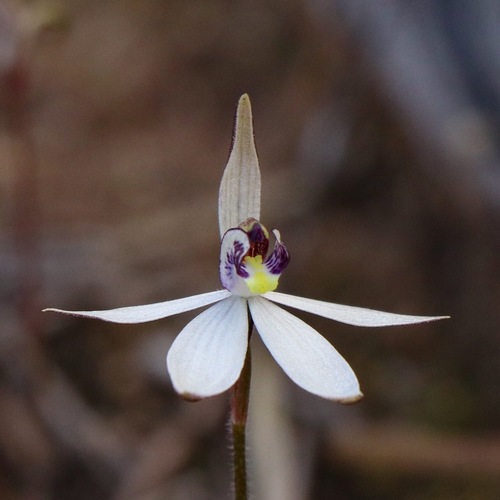
Ericksonella saccharata (basionym Caladenia saccharata Rchb.f.) is a terrestrial, perennial, deciduous, sympodial herb. It has a roughly spherical, white, fleshy tuber, with a fibrous sheath covering the tuber’s upper half. Each growing season, a new replacement tuber develops at the end of a short, root-like stolon. A single narrow linear leaf grows from the plant’s base. This leaf is pale yellowish-green on both surfaces, covered in hairs, measures 4–8 cm (2–3 in) long and 2–3 mm (0.08–0.1 in) wide, and usually has irregular reddish-purple blotches near its base. One resupinate flower is borne at the end of a hairy, wiry stem that reaches 5–15 cm (2–6 in) in height. The flower itself is 2–3 cm (0.8–1 in) long and 2–3 cm (0.8–1 in) wide, on a stalk less than 1 cm (0.4 in) long. It produces a strong, musky cinnamon scent, but contains no nectar. The two lateral sepals are similar in size and shape to the two petals; they are white, 10–15 mm (0.4–0.6 in) long, 3–4 mm (0.1–0.2 in) wide, and curve slightly forwards. The dorsal sepal is slightly narrower than the lateral sepals, and the sides of its upper half curve inwards, a shape described as “pinched”. Both sepals and petals have dark-coloured glandular hairs on their outer back surface. Like most orchids, this species has one highly modified petal that forms the central labellum. The labellum is glabrous, divided into three parts, and roughly circular when flattened. Its lateral lobes are erect and cream-coloured, marked with distinct parallel purple lines and irregular purple blotches. The central part of the labellum bears smooth yellow calli arranged in two rows. The flower’s reproductive structures are fused to the column, which is narrow, curves forwards, and has two translucent wings. Flowering occurs between August and September. After flowering, the fruit develops as a non-fleshy, glabrous, dehiscent capsule that holds many seeds. This orchid grows in a variety of soil types and habitats, including sand and clay loam. It can be found in shrubland near salt lakes, woodland, and sheoak thickets surrounding granite outcrops. Its distribution in south-western Western Australia ranges from near Paynes Find to Israelite Bay, extending inland to Coolgardie and Norseman. It occurs within the Avon Wheatbelt, Coolgardie, Esperance Plains, Jarrah Forest, Mallee and Yalgoo biogeographic regions.