About Caladenia radialis R.S.Rogers
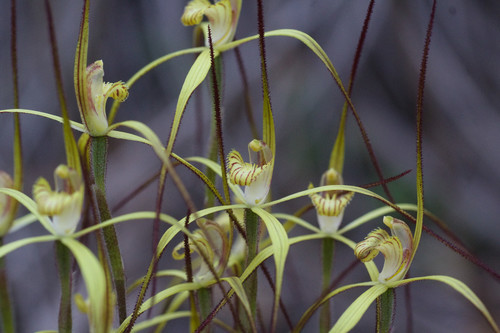
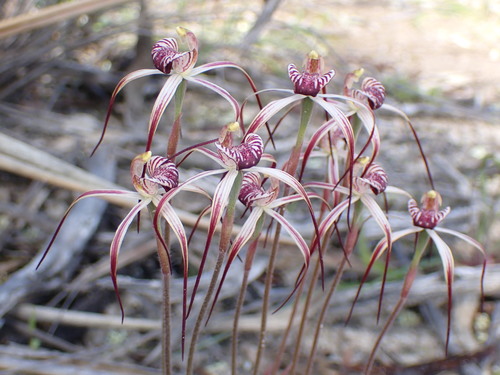
Caladenia radialis R.S.Rogers, commonly known as the drooping spider orchid, is a terrestrial, perennial, deciduous herb with an underground tuber. It often grows in clumps of up to ten individual plants following periods of good rainfall. This species produces a single erect, hairy leaf that measures 50–180 mm (2–7 in) long and approximately 6 mm (0.2 in) wide. One or two red and cream-coloured flowers are borne on a stalk that reaches 150–350 mm (6–10 in) tall. The flowers themselves are 40–50 mm (1.6–2.0 in) long and 40–80 mm (2–3 in) wide. The sepals and petals have long, brown, drooping, thread-like tips. The dorsal sepal curves forward, and is 25–45 mm (1–2 in) long and about 2 mm (0.08 in) wide. Lateral sepals and petals have similar dimensions to the dorsal sepal, though the lateral sepals are slightly wider. The labellum is 12–15 mm (0.5–0.6 in) long and 8–10 mm (0.3–0.4 in) wide, and is cream-coloured with red markings. The sides of the labellum sometimes bear a few short teeth, its tip is curled under, and a dense band of red or cream-coloured calli runs along its mid-line. Flowering occurs from August to early October. This orchid is found between Fitzgerald River National Park and Northampton in Western Australia, across the Avon Wheatbelt, Esperance Plains, Geraldton Sandplains, Jarrah Forest and Mallee biogeographic regions. It grows in a range of habitats, including on granite outcrops and near the edges of salt lakes.