About Caladenia pusilla W.M.Curtis
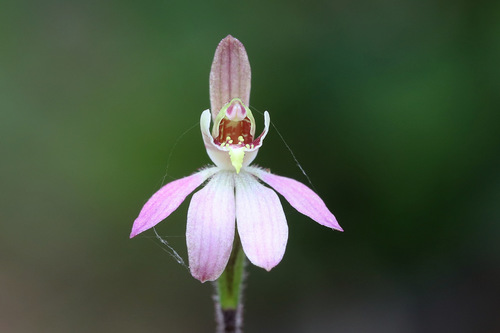
Caladenia pusilla is a terrestrial, perennial, deciduous herb that grows from an underground tuber. It produces a single erect, sparsely hairy leaf, which measures 30–60 mm (1–2 in) long and 10–15 mm (0.4–0.6 in) wide. One flower is borne on a relatively thick spike that reaches 40–100 mm (2–4 in) in height; the flower itself is 50–80 mm (2–3 in) long and 80–100 mm (3–4 in) wide. The flower is pink, with a brownish-pink back and often a white centre. The dorsal sepal is erect at its base, curves forward, and is 50–70 mm (2–3 in) long and 2–3 mm (0.08–0.1 in) wide. The lateral sepals are 50–70 mm (2–3 in) long, about 2 mm (0.08 in) wide, and are partly joined to each other. The petals are 50–60 mm (2.0–2.4 in) long, about 2 mm (0.08 in) wide, and spread widely. The labellum is white or pink with red bars, and measures 4–5 mm (0.16–0.20 in) long and wide. The sides of the labellum sometimes bear a few short teeth near the tip, which curls under. Two rows of stalked calli with yellow heads run along the mid-line of the labellum. Flowering occurs from September to November. Flowers are only open for one or two days, sometimes barely open, and are self-pollinating. This orchid is widespread but localised in Victoria, where it usually grows in moist coastal heath, and sometimes in forests further inland. It grows in similar habitats in New South Wales, south from Wellington. In South Australia, it is found in the south-eastern corner of the state, especially on the Yorke Peninsula and Kangaroo Island. In Tasmania, it grows in coastal areas, including on King Island and Flinders Island. In New Zealand, it grows in scrub on the North Island.