About Caladenia prolata D.L.Jones
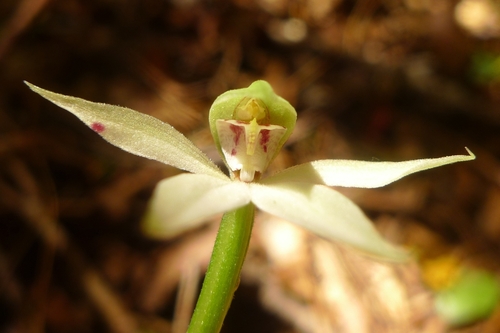
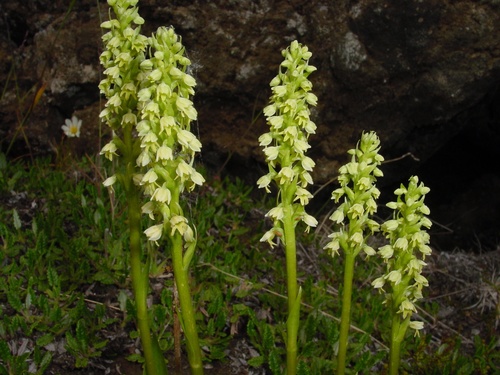
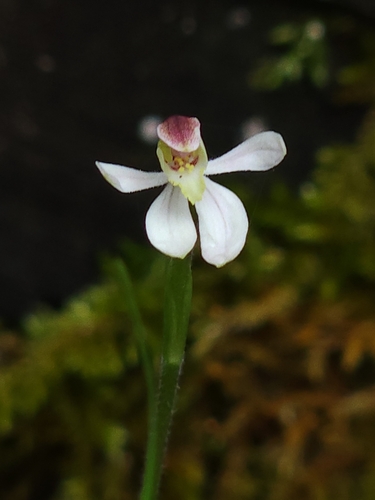
Caladenia prolata is a terrestrial, perennial, deciduous herb with an underground tuber, that typically grows as a solitary individual. It produces a single erect, hairy leaf, that measures 120–200 mm (5–8 in) long and 3–5 mm (0.1–0.2 in) wide, and has a reddish or purplish base. One or two dull white flowers are borne on a stalk 120–240 mm (5–9 in) tall. The flowers are hairy, greenish with red stripes on their outer surface, 8–10 mm (0.3–0.4 in) long, and 12–15 mm (0.5–0.6 in) wide. The dorsal sepal curves forward to partially form a hood over the column; it is 11–14 mm (0.4–0.6 in) long and 2–4 mm (0.08–0.2 in) wide. The lateral sepals are linear to lance-shaped, slightly sickle-shaped, 11–14 mm (0.4–0.6 in) long, about 3 mm (0.1 in) wide, and spread slightly apart from each other. The petals are 10–13 mm (0.4–0.5 in) long and about 3 mm (0.1 in) wide and spread widely apart. The labellum is dull pink with dark red bars and a yellow tip, measuring 5–6 mm (0.20–0.24 in) long and 5–7 mm (0.2–0.3 in) wide. The sides of the labellum have four to six short teeth near the curled-under tip. Two rows of white or yellow calli run along the mid-line of the labellum. Flowering takes place in October and November. This orchid has been recorded in scattered locations across Victoria, south-eastern South Australia, and on Flinders Island and Deal Island in Tasmania. It grows in coastal scrub, heathy forest, and sometimes on granite outcrops.