About Caladenia polychroma Hopper & A.P.Br.
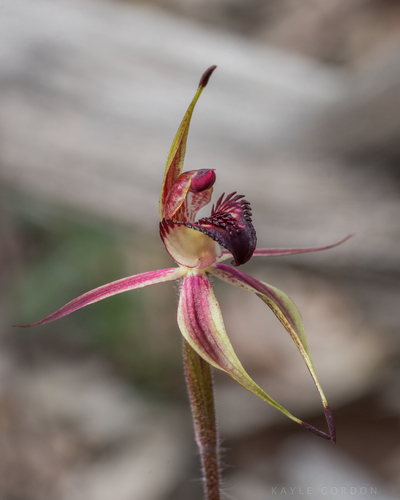
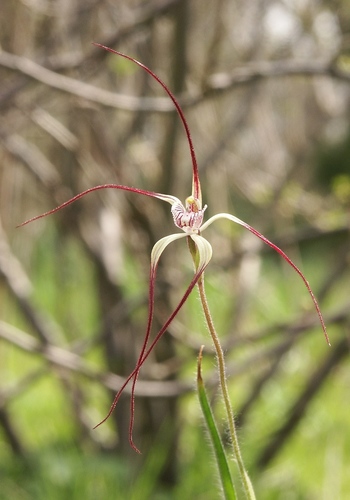
Caladenia polychroma is a terrestrial, perennial, deciduous herb that grows from an underground tuber and often forms clumps. It produces a single erect, hairy leaf that measures 70–120 mm (3–5 in) long and about 4 mm (0.2 in) wide. One or two variably colored creamy flowers, marked with red, pink, yellow, and white, are borne on a stalk 200–300 mm (8–10 in) tall. Each flower is 100–150 mm (4–6 in) long and 80–120 mm (3–5 in) wide. The sepals and petals have long, thin, drooping, thread-like ends. The erect dorsal sepal is 45–100 mm (2–4 in) long and 2–3 mm (0.08–0.1 in) wide. The lateral sepals are 45–100 mm (2–4 in) long and 3–4 mm (0.1–0.2 in) wide, curving stiffly downwards. The petals are 45–90 mm (2–4 in) long and 2–3 mm (0.08–0.1 in) wide, and are arranged the same way as the lateral sepals. The labellum is 10–17 mm (0.4–0.7 in) long and 10–13 mm (0.4–0.5 in) wide, and is cream-coloured to yellow with red lines, spots, and blotches. The sides of the labellum have short, blunt teeth, and its tip is curled under. Two rows of anvil-shaped, cream-coloured calli run along the mid-line of the labellum. This species flowers from September to October. Common name Joseph's spider orchid, it occurs between Frankland and Fitzgerald River National Park in the Avon Wheatbelt, Esperance Plains, Jarrah Forest, and Mallee biogeographic regions of Western Australia, and is most common between Cranbrook and Kojonup. It grows near seasonally wet areas and drainage lines.