About Caladenia picta (Nicholls) M.A.Clem. & D.L.Jones ex A.D.Chapm.
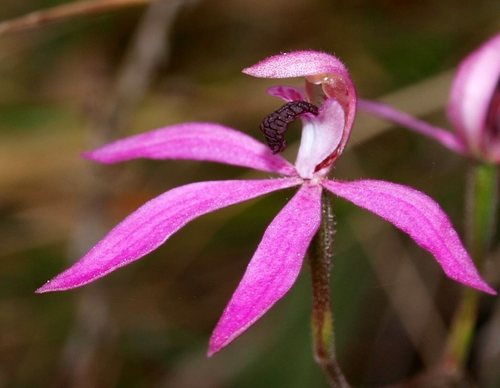
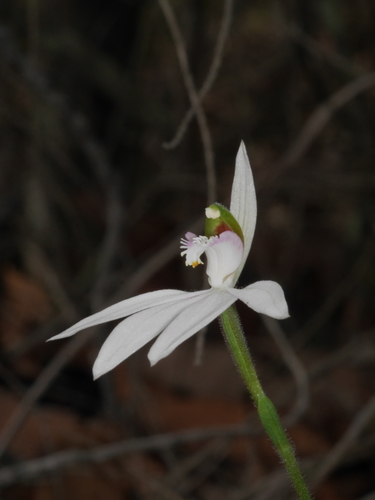
Caladenia picta is a terrestrial, perennial, deciduous herb that grows from an underground tuber. It produces a single, sparsely hairy, linear leaf that measures 60–120 mm (2–5 in) long and 2–3 mm (0.08–0.1 in) wide. One flower, 20–25 mm (0.8–1 in) long and 25–30 mm (0.98–1.2 in) wide, is borne on a stalk 80–150 mm (3–6 in) tall. The sepals and petals are white to pink on the front surface, greenish-white on the back surface, and spread out in a fan-like arrangement. The dorsal sepal is erect or slightly curved forward, measuring 15–20 mm (0.6–0.8 in) long and 3–4 mm (0.1–0.2 in) wide. The lateral sepals are 18–23 mm (0.7–0.9 in) long and 5–7 mm (0.2–0.3 in) wide, while the petals are 15–20 mm (0.6–0.8 in) long and 4–5 mm (0.16–0.20 in) wide. The labellum is 7–10 mm (0.3–0.4 in) long and 5–7 mm (0.2–0.3 in) wide, usually white with pink margins. The sides of the labellum curve upwards strongly, and the tip curls downwards; the tip is orange-yellow and has narrow teeth along its edge. Two rows of calli with clubbed heads are located in the centre of the labellum. Flowering occurs from April to June. This species, commonly called painted fingers, is found in coastal districts of New South Wales, Australia, south from Newcastle, where it grows in eucalyptus woodland or forest.