About Caladenia parva G.W.Carr
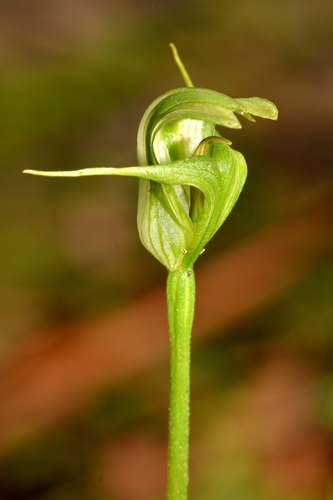
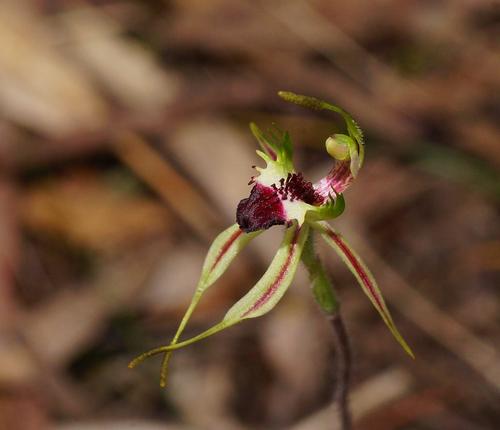
Caladenia parva is a terrestrial, perennial, deciduous herb that grows from an underground tuber. It produces a single leaf, 30–100 mm (1–4 in) long and 5–10 mm (0.2–0.4 in) wide, which often has red spots near its base. One or two greenish flowers with red stripes are borne on a stalk 50–150 mm (2–6 in) tall. The sepals have thick, brown, club-shaped glandular tips that are 3–6 mm (0.1–0.2 in) long. The dorsal sepal curves forward, is 25–35 mm (0.98–1.4 in) long and about 2 mm (0.08 in) wide. The lateral sepals are 25–35 mm (0.98–1.4 in) long, about 3 mm (0.1 in) wide, and grow either parallel to each other or sometimes cross over one another. The petals are 20–26 mm (0.8–1 in) long, 1–2 mm (0.04–0.08 in) wide, and curve downwards. The labellum is greenish, with a white central region and a dark red, undercurled tip. It measures 11–14 mm (0.4–0.6 in) long and 10–12 mm (0.4–0.5 in) wide, and bears thin green teeth up to 3 mm (0.1 in) long along its sides. There are four rows of reddish-black calli up to 2 mm (0.08 in) long in the centre of the labellum. Flowering occurs in September and October. This species, commonly called the small spider orchid, is found in scattered locations across southern Victoria and the far south-eastern corner of South Australia, where it grows in woodland and coastal scrub.