About Caladenia orientalis (G.W.Carr) Hopper & A.P.Br.
Growth Habit
Caladenia orientalis is a terrestrial, perennial, deciduous herb.
Underground and Vegetative Structure
It has a small, spherical underground tuber, and a single leaf measuring 100–150 mm (4–6 in) long and 10–15 mm (0.4–0.6 in) wide.
Inflorescence and Flower Size
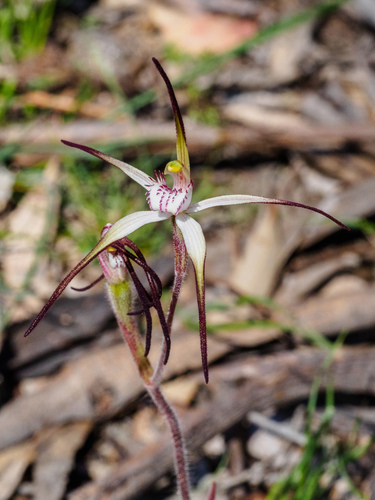
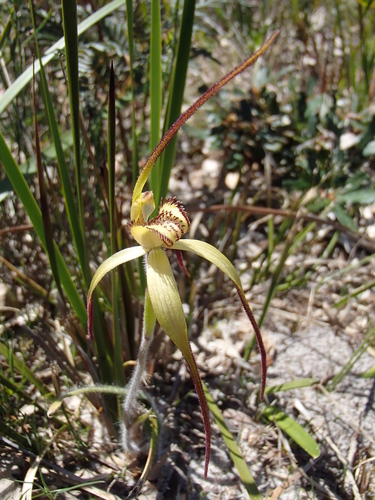
One or two creamy-white to yellowish-green flowers, 70–100 mm (3–4 in) across, grow on a stalk that is 100–200 mm (4–8 in) tall.
Sepal and Petal Tips
The sepals and petals taper to thin tips that range in color from brown to black.
Dorsal Sepal Morphology
The dorsal sepal is erect, 90–120 mm (4–5 in) long, and about 3 mm (0.1 in) wide.
Lateral Sepal Morphology
The lateral sepals are 90–120 mm (4–5 in) long and 4–6 mm (0.16–0.24 in) wide, and spread apart from each other.
Petal Morphology
The petals are 70–100 mm (3–4 in) long and 2–3 mm (0.08–0.1 in) wide; they curve downwards and have drooping tips.
Labellum Base Characteristics
The labellum is 18–22 mm (0.7–0.9 in) long and 8–12 mm (0.3–0.5 in) wide, and is cream-colored.
Labellum Margins and Tip
It has many red teeth up to 2 mm (0.08 in) long along its sides, and its tip curls underneath.
Labellum Calli
Four or six rows of reddish, foot-shaped calli that are 2 mm (0.08 in) long run along the mid-line of the labellum, decreasing in length towards the tip.
Flowering Period
Flowering occurs between September and October, and generally takes place after summer bushfires.
Species Similarity and Hybrids
This species is hard to distinguish from Caladenia patersonii and C. fragrantissima, and sometimes forms hybrids with C. tessellata.
Current Distribution
While this species had a wider distribution in the past, 2010 surveys found the eastern spider orchid only occurs between Port Campbell and Yarram, in the South East Coastal Plain biogeographic region.
Habitat
It grows in coastal heath and woodland with a heathy understorey.