About Caladenia nothofageti D.L.Jones, Molloy & M.A.Clem.
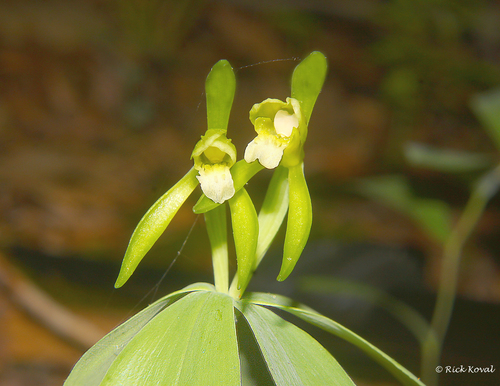
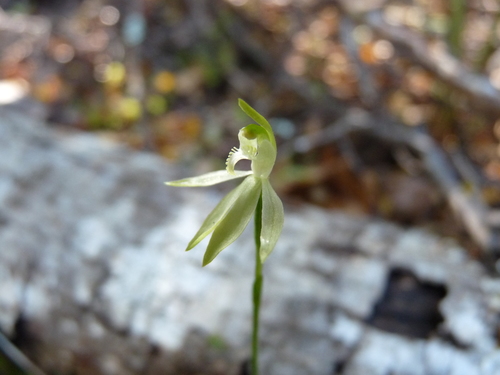
Caladenia nothofageti, commonly known as beech caladenia, is a terrestrial, perennial, deciduous herb that grows from an underground tuber. It produces a single bright green, sparsely hairy leaf that measures 40–180 mm (2–7 in) long and 1–3 mm (0.04–0.1 in) wide. One, or occasionally two, white flowers with a greenish-white back are borne on a thin, wiry stem 50–100 mm (2–4 in) tall; each flower measures 14–16 mm (0.6 in) across. The sepals and petals of this species are 8–9.5 mm (0.3–0.4 in) long and 2–3 mm (0.08–0.1 in) wide. The dorsal sepal stands erect or curves slightly forward, while the lateral sepals and petals are held horizontally or angled slightly downwards. The labellum is 5–7 mm (0.2–0.3 in) long and about 5 mm (0.2 in) wide, white or rarely cream-coloured with faint red bars. The sides of the labellum curve upwards to partly surround the column, with four to six blunt teeth along the front edges, and the tip of the labellum curls under. Two rows of pale yellow calli run along the centre of the labellum. Flowering takes place from November to January; flowers are self-pollinating and only open for one to two days. This orchid occurs on both the North and South Island of New Zealand, where it grows in Nothofagus forest in well-lit sites.